


At 2:15 p.m. on Friday, July 1, a “photochemical smog advisory” was issued.
The previous advisory was issued on Monday, August 17, 2020, so this is the first one in about two years.
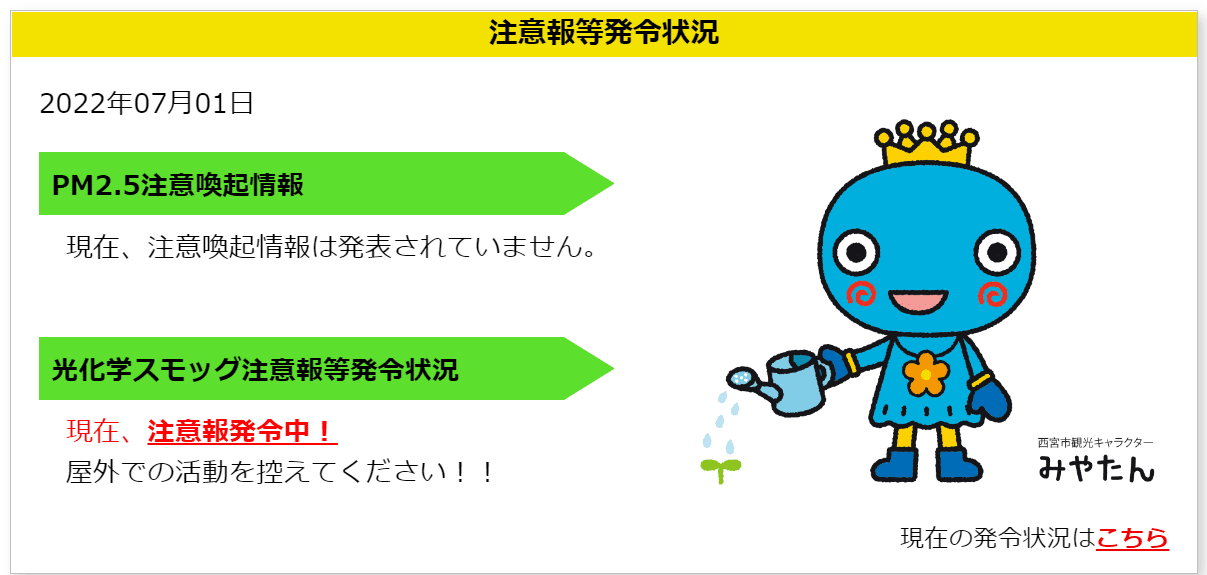
Here it is↓↓
※Screenshot from Nishinomiya no Sora(2022/7/1)
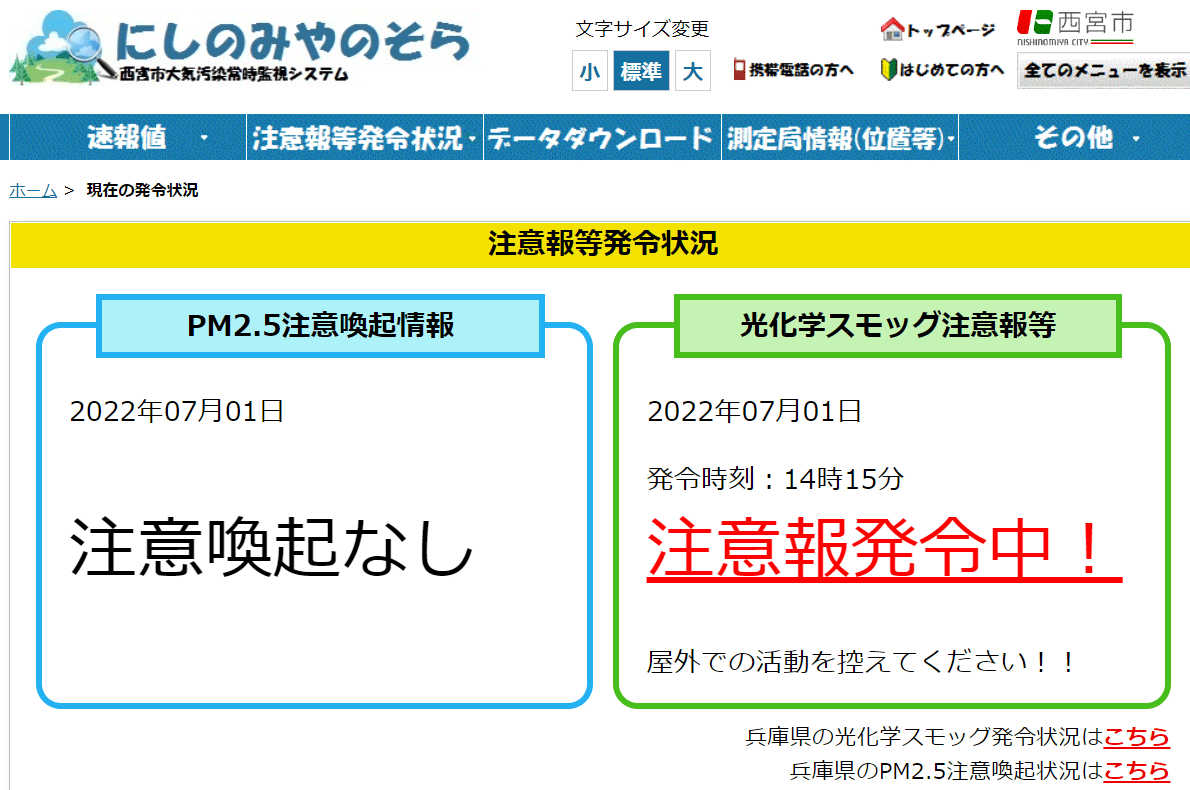
It says, “Please refrain from outdoor activities.”
Photochemical smog advisory status
↓↓
※Screenshot from Hyogo Air Environment(2022/7/1)
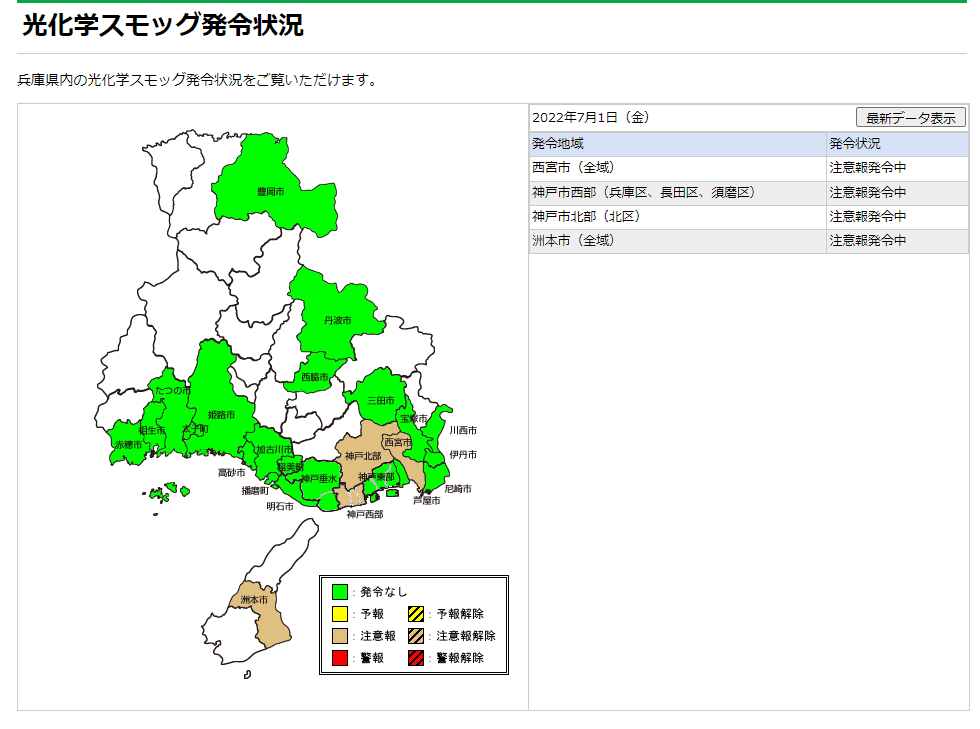
It looks like advisories have also been issued in western and northern Kobe City.
目次
I Googled photochemical smog
I searched for photochemical smog on Google.
To explain it in very simple terms, it goes like this:
- Exhaust gases from cars and factories (nitrogen oxides)
- Those exhaust gases are exposed to ultraviolet rays from the sun
- They become pollutants (called photochemical oxidants)
- When the amount of pollutants increases, it turns white and fog-like
- That is photochemical smog
Photochemical smog is more likely to occur from April to October when:
- The wind is weak
- The temperature is high
- The sunlight is strong
Let me briefly explain each one.
The wind is weak
When the wind is weak, the ingredients that cause photochemical smog, exhaust gases from cars and factories (nitrogen oxides), stay in the area. When the wind is strong, they get dispersed.
The temperature is high
When exhaust gases (nitrogen oxides) are exposed to ultraviolet rays, a chemical reaction occurs. They apparently become pollutants called photochemical oxidants, and chemical reactions seem to happen more easily when the temperature is high.
The sunlight is strong
Ultraviolet rays are essential for producing the pollutant known as photochemical oxidants. Because “strong sunlight = a large amount of ultraviolet rays,” photochemical smog is more likely to occur.
What should you do when a photochemical smog advisory is issued?
- Avoid going outside as much as possible
- If you are outdoors, go indoors and rest
- Close the windows
- Avoid driving
That is the guidance.
In particular, people with bronchial asthma, infants, elderly people, and those in poor health are more likely to develop symptoms.
Since car exhaust is one of the causes, avoiding nonessential driving seems like it would have a major effect.
What symptoms can appear?
Symptoms include stinging or irritated eyes, watery eyes, and a sore throat.
Other symptoms are said to include headaches, nausea, and difficulty breathing.
The treatment instructions from the Tokyo Metropolitan Tama-Kodaira Public Health Center were easy to understand.
Eye symptoms
(1)Please rinse your eyes with tap water.
(2)If symptoms do not improve within 20 to 30 minutes and pain continues, please see an ophthalmologist.
(3)When using eye drops, rinse your eyes with tap water first, then use eye drops that have been prescribed in advance by an ophthalmologist.Throat symptoms
Please gargle with tap water.If your condition does not change after rinsing your eyes or gargling, or if you feel short of breath or tightness in your chest, please see a doctor.
Quoted from treatment instructions from the Tokyo Metropolitan Tama-Kodaira Public Health Center(2019/5/27)
Finally
Today’s temperature is really intense, and Miyatan is also saying, “Please refrain from outdoor activities,” so it would be best to spend the day in a comfortable, air-conditioned room if possible.
If you are outdoors, please take extra care.