



Nishinomiya City has two official symbols: the city emblem and the city flag.
If you live in Nishinomiya, you’ve probably seen them countless times.
Of course, each of these two symbols has its own meaning, but do you know what they represent?
Nishinomiya City Flag
(Source: Nishinomiya City)

This is the Nishinomiya City Flag.
As you can see, it features the hiragana character “に.” The red represents the sun and happiness, while the green represents the nature of the Rokko Mountains. The design is said to symbolize a “city of greenery and happiness.”
It was established in November 1970.
Nishinomiya City Emblem
(Source: Nishinomiya City)

This is the Nishinomiya City Emblem in question.
The character in the center is “西” written in seal script, and the design surrounds this “西” with three katakana “ヤ” characters. In other words, the three “ヤ” make “miya.”
So that’s why the straight lines are slightly offset.(Hyogo Prefectural Nishinomiya High School has also written about the city emblem)
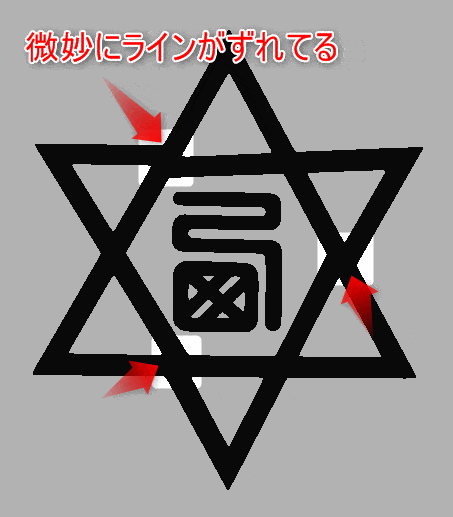
The point is that it is surrounded by three katakana “ヤ” characters, and is definitely not simply a hexagram.
It was established in April 1926, when the area was still Nishinomiya Town.
A video that makes the “ヤ” easy to see ↓
Urban Legends About the City Emblem
The origin of the design is as described above, but since the city emblem does look like a hexagram, you sometimes hear all sorts of rumors about it.
“There’s a hexagram on a lantern at Ise Jingu, so maybe the roots of the Japanese people are Jewish…”
“Maybe the fact that Nishinomiya City, home to Nishinomiya Shrine, has a hexagram as its city emblem is connected to that…”
“Maybe Nishinomiya was once a land controlled by Jews…”
And so on.
Personally, I don’t think those kinds of stories are very credible.
If the Nishinomiya City Emblem really were meant to represent Judaism, I don’t think they would have done something as disrespectful as designing it with the straight lines shifted. If anything, it seems like they may have deliberately offset them to show that “this has nothing to do with a hexagram.”
To begin with, the Star of David is shaped like a hexagram, but that doesn’t mean every hexagram is the Star of David. After all, not every circle is a symbol of Japan.
The hexagram is also known in Japan as the “kagome-mon,” and it is one of the patterns that has existed here since ancient times.
Geometric shapes like hexagrams and regular hexagons are also found widely in nature, and they make sense in many ways, so it’s not strange at all for them to be used anywhere in the world.
So I believe the Nishinomiya City Emblem and the Star of David are unrelated, but what do you think?
- 何か関係あると思う32.9%(227票)
- いやいや、関係ないでしょう67.1%(463票)