
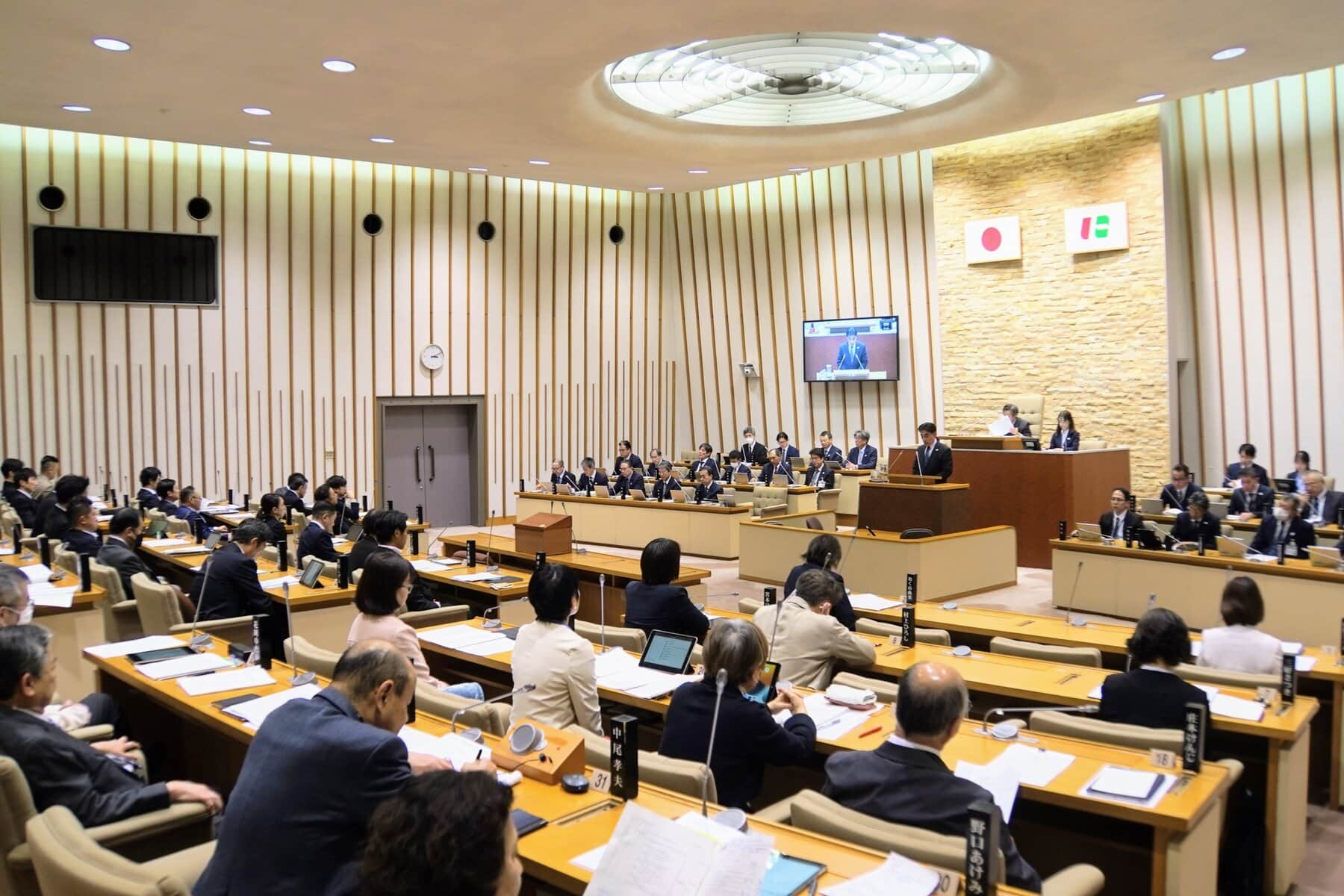

Summary of the public debate hosted by the Junior Chamber for the Nishinomiya mayoral election, Part 2: Money〜
If you haven’t read Part 1 yet, start here↓
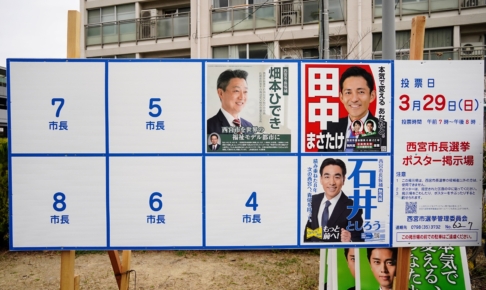
In the previous childcare section, the candidates brought up all kinds of policies, like support for childcare workers and free medical care…

This was actually the part of the debate that got the most heated.
目次
First, what should we know? How are Nishinomiya City’s finances doing right now?
Have you ever vaguely heard that “Nishinomiya City’s finances are in trouble”?
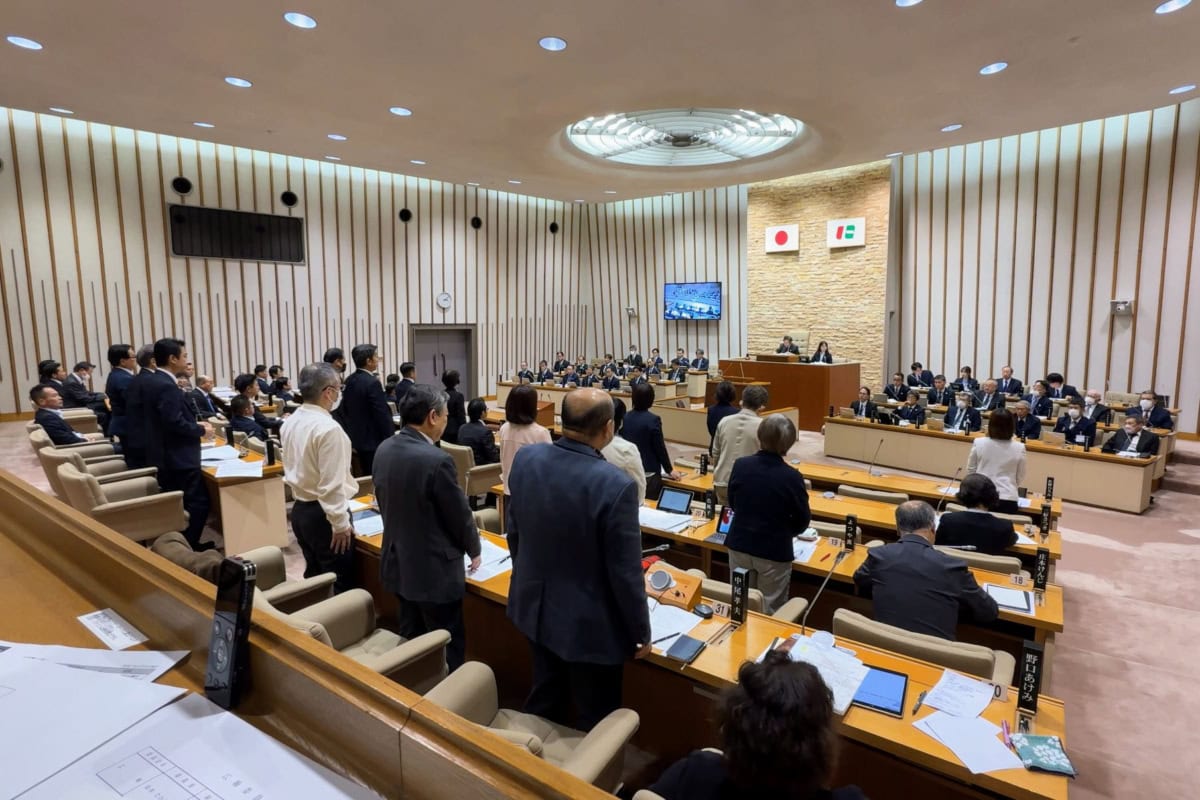
Last year, there was news that the proposed budget was rejected by the city assembly… On the other hand, the city newsletter says things are “improving”…
So, what’s actually going on?
To put it simply, imagine a household budget:
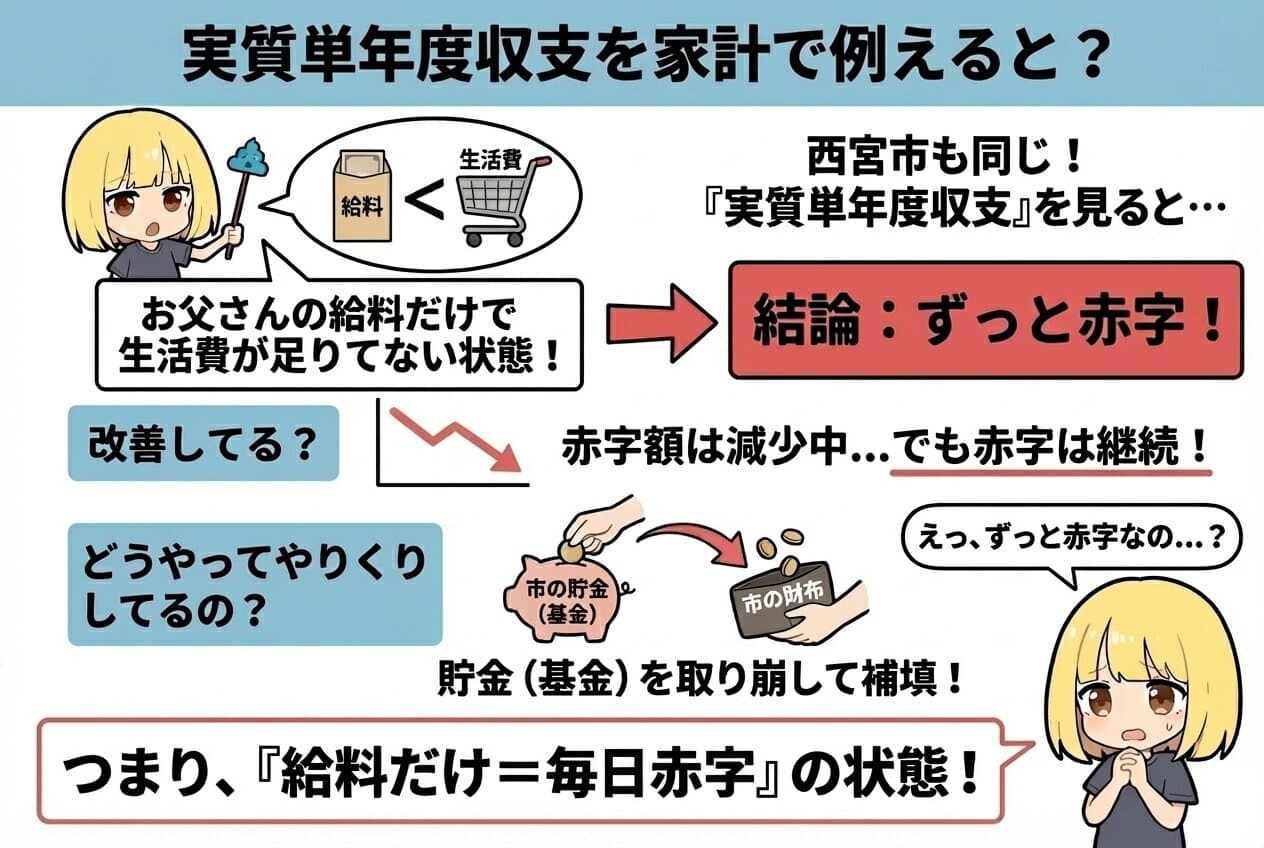
The figure used to check that is called the “real single-year balance(whether the city can make ends meet on its regular income alone),” and Nishinomiya City has been in the red for years.
So when people say it’s “improving,” they mean the amount of the deficit has been shrinking. The deficit itself is still continuing
So how is the city covering that deficit…?
It’s withdrawing savings to make up the shortfall.
In other words, “there is money in the wallet,” but “on salary alone, it’s running a monthly deficit.”
In numbers, it looks like this↓
Deficit based only on regular income (real single-year balance)
FY2019 ▲5.04 billion yen
↓
FY2022 ▲4.24 billion yen
(the year it was widely covered on TV and in newspapers)
↓
FY2024 ▲1.49 billion yen
The deficit has been getting smaller, but it is still a deficit.
(Source: Nishinomiya City Fiscal Structure Improvement Implementation Plan progress materials)
I thought, “Wait, it is improving!”
“It’s down to ▲1.49 billion yen”
Looking at the numbers, it really does seem like a major improvement! This is the part the city newsletter described as improvement
But what’s inside that improvement is pretty important…
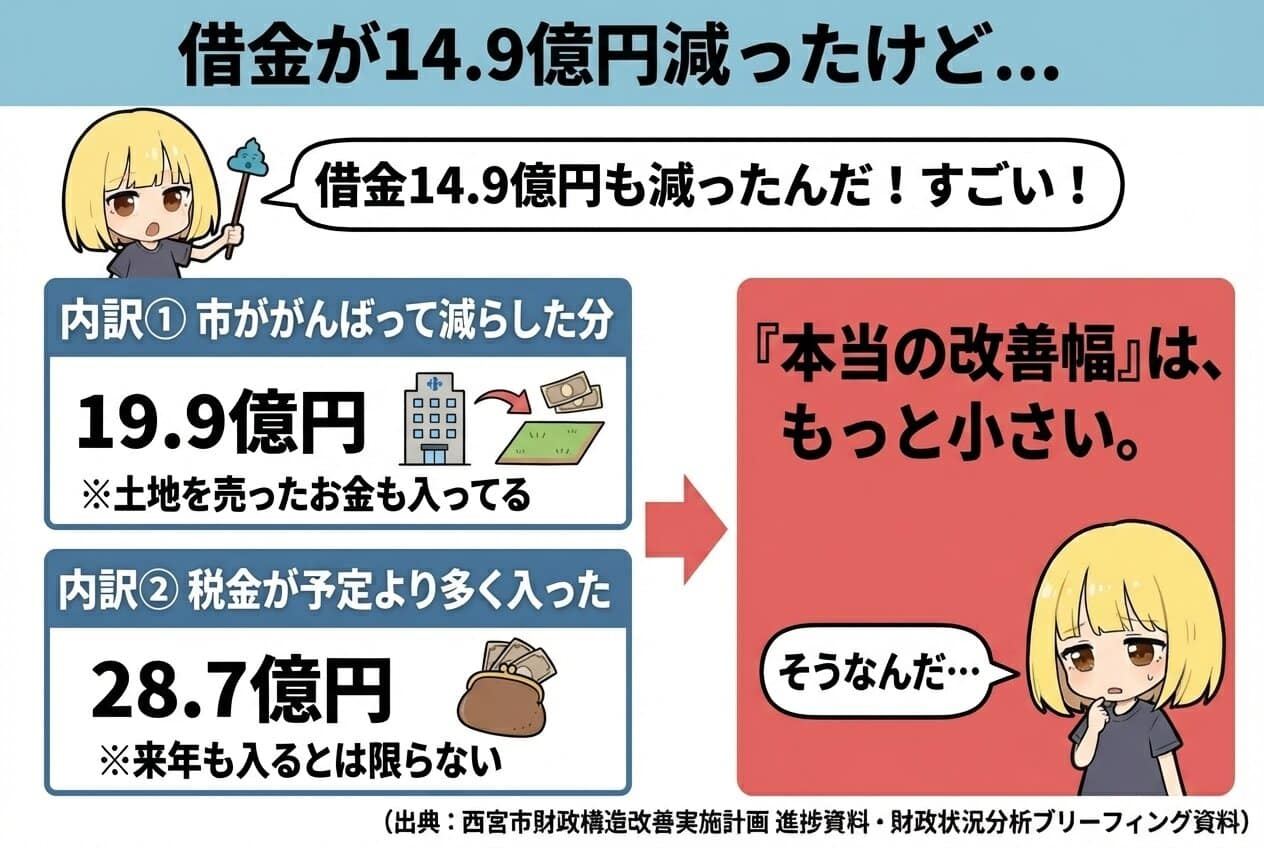
However, this includes 990 million yen from selling city-owned land
(Once land is sold, it’s gone, so the same amount won’t come in again next year)
❷ More revenue than expected from municipal tax, prefectural tax grants, etc. → 2.87 billion yen
(There is no guarantee the same amount will come in again next year)
So it’s true that city initiatives improved things by 1.99 billion yen. But some of that was one-time income, like land sales, and the 2.87 billion yen upside in tax revenue also had a big element of good timing.
If you look only at “improvements that will keep going from next year onward,” the picture is different.
(Source: Nishinomiya City Fiscal Structure Improvement Implementation Plan progress materials and fiscal situation analysis briefing materials)
How big is this in terms of Nishinomiya City’s overall scale?
Even after excluding land sales and higher-than-expected tax revenue, FY2024 still saw an improvement of around 1 billion yen. Of that, pure spending cuts amounted to 800 million yen. Nishinomiya City’s general account expenditures total 204.5 billion yen, and personnel costs alone are 38.9 billion yen, so 800 million yen is not a number you can simply dismiss as “nothing much.” That said, it’s still hard to say this alone means the city’s finances have been rebuilt. That’s the general idea. (Sources are here and here)
※The 38.9 billion yen mentioned here is based on the general account settlement
Personnel costs seem to have increased by 6 billion yen over 10 years
This may not be very widely known, but…
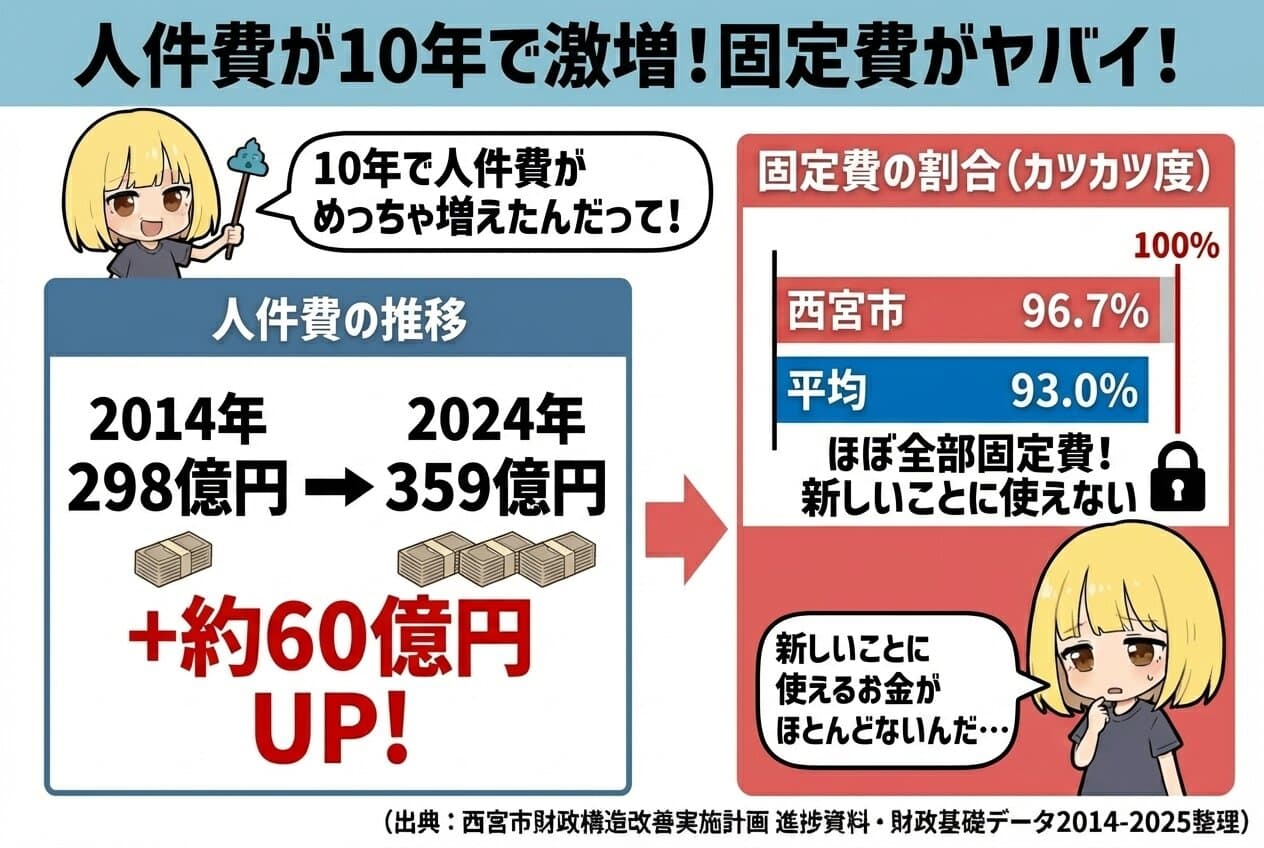
Nishinomiya City’s personnel costs (salaries for city employees, etc.) were:
FY2014 29.8 billion yen
↓
FY2024 35.9 billion yen
That’s an increase of about 6 billion yen in 10 years
※These figures are based on fiscal structure improvement progress materials. In the general account settlement report, FY2024 personnel costs are 38.91 billion yen, so the accounting category differs depending on the source. (Basically, it’s like whether or not you include eating out in food expenses; the total changes depending on what’s included.)
There’s a figure called the “ordinary balance ratio,” which shows how much of the money that comes in every year is eaten up by fixed costs.
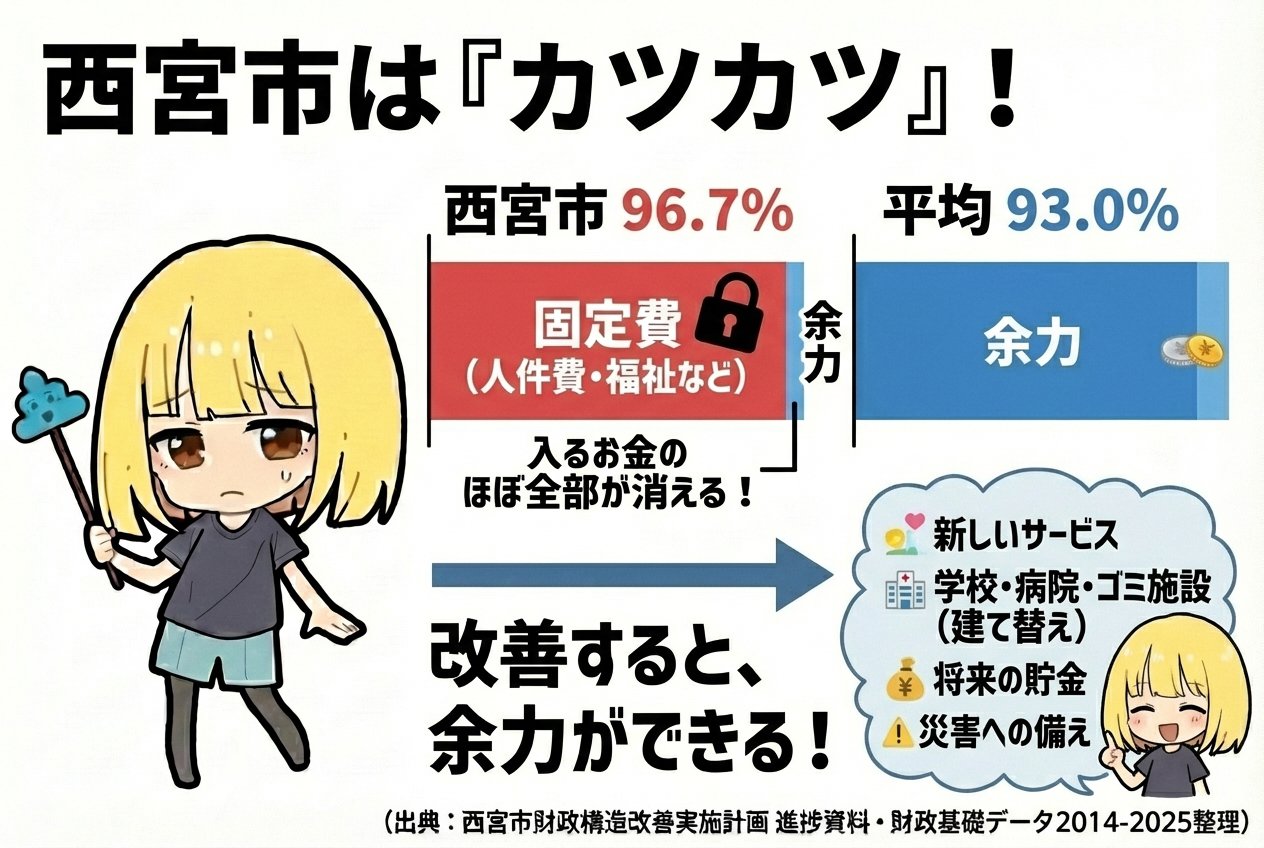
Nishinomiya City 96.7%
Average for core cities 93.0%
This means Nishinomiya City has a very heavy burden of fixed costs that must be paid every year.
The closer it is to 100%, the tighter the budget is. In Nishinomiya City, almost all of the money that comes in each year is used up by fixed expenses such as personnel costs and welfare. There is almost no money left for new initiatives.
If this improves, the city would have more room for things like:
・Major rebuilding and infrastructure projects (schools, waste facilities, hospitals, libraries, etc.)
・Saving into funds (savings for the future)
・Preparing for unexpected needs (funds used when there is a shortage due to disasters, etc.)
・New services of some kind
That’s the kind of breathing room it would create.
(Source: Nishinomiya City Fiscal Structure Improvement Implementation Plan progress materials and fiscal basic data 2014-2025 summary)
So in this situation, what would the 3 candidates do?
By the way, the “RAT RACE” clothing they’re wearing is a very Nishinomiya local apparel brand, so Nishi2 just added it on our own〜
| Ishii | Tanaka | Hatamoto | |
|---|---|---|---|
| How to reduce spending | Move forward with the current improvement plan. Continue reducing ordinary expenses | Says the current plan is not enough, and wants to quickly review personnel costs (don’t take 5 years) | Negative about cutting personnel costs. “Honestly, there aren’t many places left to cut further” |
| How to earn revenue | Municipal tax revenue has increased from 85.6 billion yen at the time he took office to 91.6 billion yen. Increase tax revenue by making Nishinomiya a “city where people can work” | Do something about the outflow caused by hometown tax donations, and support local industries | Solving welfare issues can become a business opportunity |
| Position | Continue fiscal improvement while also making necessary investments in childcare, medical care, and urban development | Prioritize fiscal reconstruction first. Rebuild finances through measures such as reviewing personnel costs, then invest | Sees limited room for major cuts, and emphasizes using AI/DX and a “revenue-generating” mindset |