
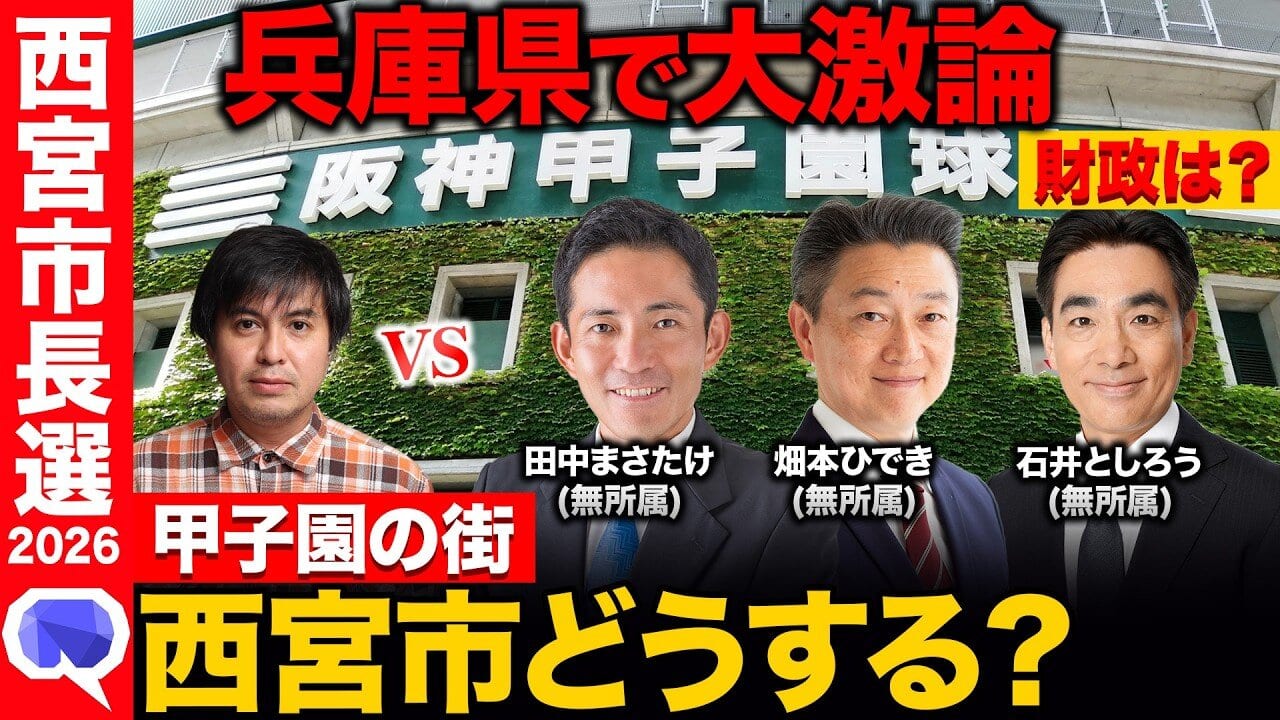
ReHacQ’s Nishinomiya Mayoral Election Debate Got Heated in 5 Key Takeaways

This page is automatically translated. Please refer to the original Japanese for accuracy.
しゃちょ美@にしつー
にしつー

Ahead of the Nishinomiya mayoral election, ReHacQ (YouTube) held a debate with Takahashi and the three candidates〜

What is ReHacQ?

ReHacQ is a live-streamed program where people can speak more frankly than they usually would on TV. Host Takahashi asks these perfectly timed questions from a “wait, I don’t quite get it” perspective. There’s also a bit more time to talk, so I think it’s easier to see gaps in wording, evasions, true feelings, and even each person’s character〜

It was really worth watching.

That said, honestly, there were probably quite a few people who, partway through, found themselves thinking, “Wait, what were they arguing about just now?”

Because what they were clashing over wasn’t about liking or disliking each other. It was more like:

・How the budget gets passed 💰
・How to reduce personnel costs 👤
・What to do with public kindergartens and nursery schools 👶
・How involved the mayor should be with the new hospital 🏥
・Garbage bag rules 🗑️

These may have been topics that are hard to follow unless you know the basics.

So this time, Nishi2 will break down the five heated points in an easy-to-understand way〜

Rather than looking at who won or lost, this is an article about “why they clashed” and “how it relates to residents’ everyday lives.”

※Some statements from the debate have been reworded by Nishi2 to make them easier to understand. Please check the video for the exact exchange〜
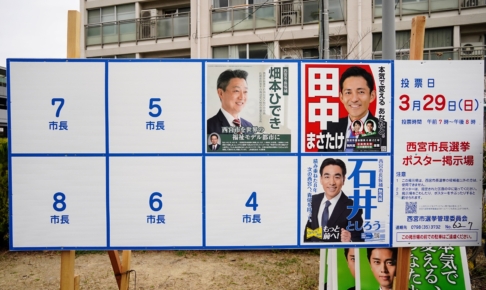
💡It’ll be easier to understand if you read these first
Nishi2 also summarized the Junior Chamber debate in three parts↓

A roundup of the three Nishinomiya mayoral candidates’ childcare policies and what they say about waitlisted children

2026年3月22日

Nishinomiya Mayoral Election Debate Money Edition Summary Explaining the City’s Finances

2026年3月24日

Nishinomiya Mayoral Election Debate Recap Candidates Ask Each Other Tough Questions

2026年3月25日

We covered the rough explanations of finances and children waiting for childcare spots there, so this time we’ll move through things quickly〜

❶ What was Nishinomiya’s first-ever “budget didn’t pass” situation?

This was the most intense part 🔥.

For the first time in Nishinomiya’s 100-year history, the annual budget proposal did not pass the city council. How should we view that?
Getting the budget passed by the end of March was my greatest responsibility. I acknowledge there was a lack of communication with the council

If it had ended there, it would have just been, “Okay, he’s reflecting on it.” But what came next was the real issue.
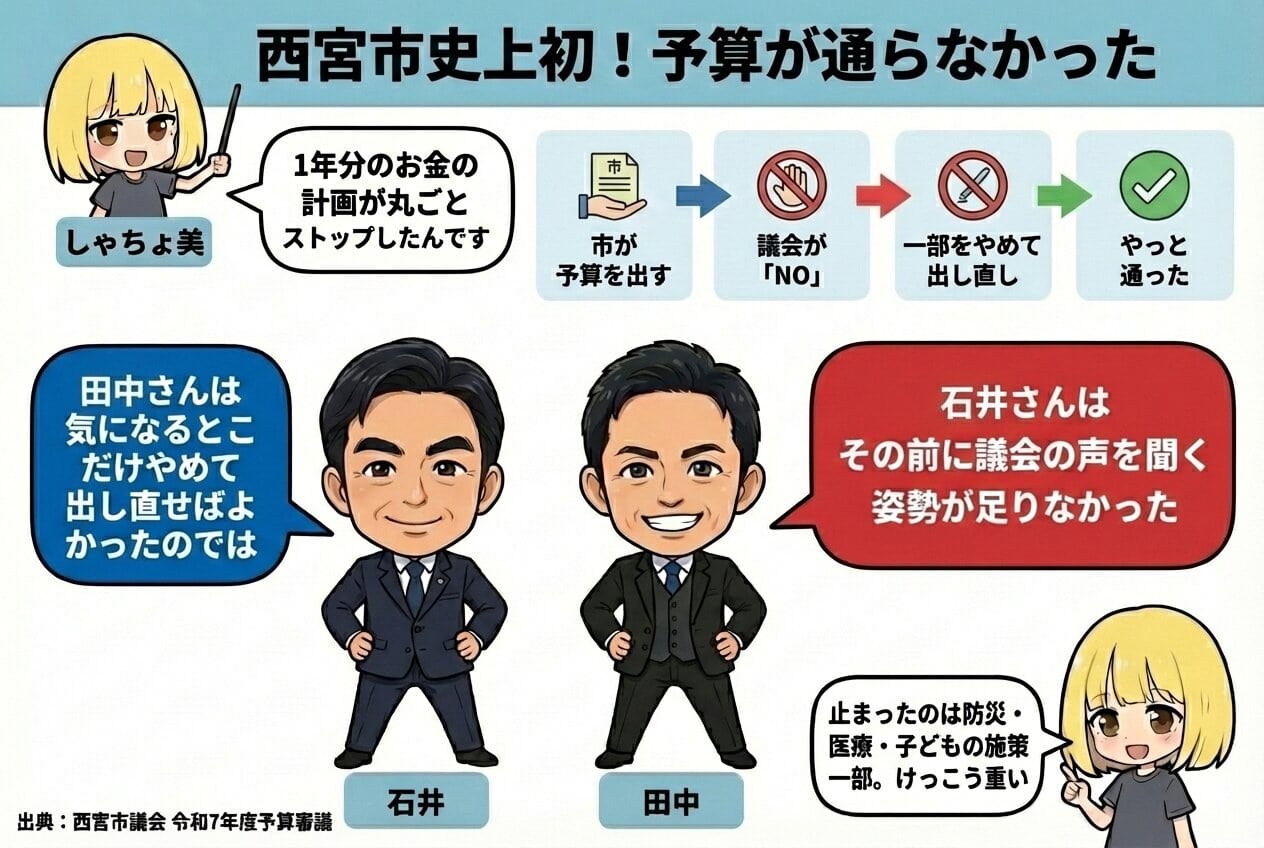
Before it reached the point where it wouldn’t pass, couldn’t you have removed the budget items people were concerned about, resubmitted it, and gotten it passed? The items that were actually dropped included the disaster prevention app and the community transfer of school club activities. Altogether, it was around 100 to 200 million yen
The council doesn’t have as much detailed information as city hall does. And with budgets like personnel costs, the council alone can’t simply say, “Let’s cut this part and move the money over there.” There wasn’t time to create an amendment either. That’s the reality of local assemblies
If you compare it to a household budget, it’s like the entire money plan for the year failed to get approved. What stopped were things like the disaster prevention app and some child-related measures

In other words, the gap here is that “Ishii sees it as something that could have passed if it had been resubmitted,” while “Tanaka sees it as a lack of willingness to listen to the council before it got to that point.”

❷ Personnel costs: how exactly will they be reduced?

As we wrote in Part ② on money, Nishinomiya’s personnel costs have increased by about 6 billion yen over 10 years. Almost all of the money that comes in each year is being eaten up by fixed costs.

Nishinomiya Mayoral Election Debate Money Edition Summary Explaining the City’s Finances

2026年3月24日

ReHacQ dug into this in even more concrete detail.
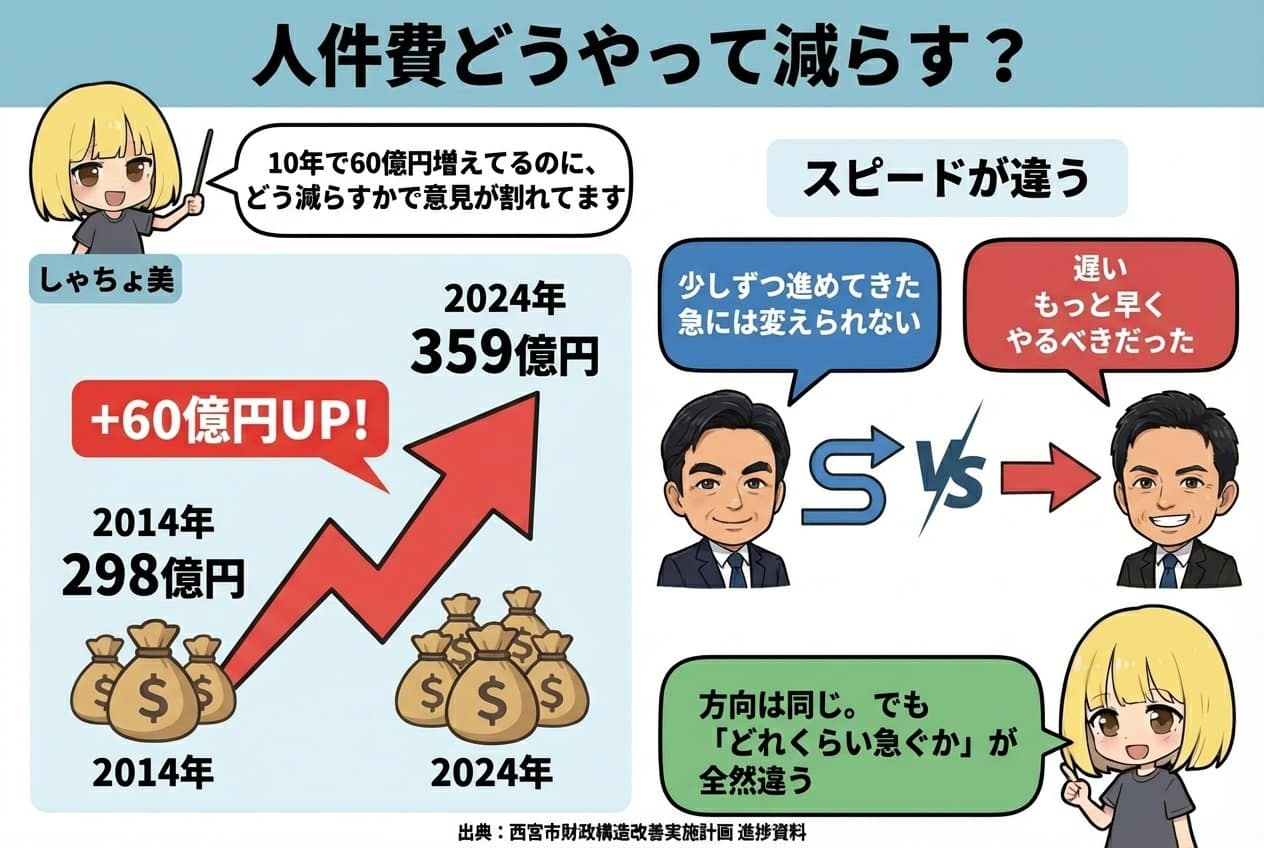
Even though services for residents are being reduced and residents’ burdens are increasing, personnel costs haven’t really gone down. Isn’t that too slow?
When I took office, personnel costs per employee were the second or third highest among core cities, but now they’ve dropped to around eighth. I have to accept criticism that we may have been able to move a little faster. But this isn’t something that can be changed suddenly after years of buildup
Ishii’s admission that “we may have been able to move a little faster” was a pretty significant statement. In response to Tanaka’s “it’s too slow,” the direction they’re trying to go is basically the same, but the speed is different

Then Takahashi asked, “What would you do if you were Tanaka?” And that leads into the next topic.

❸ What should happen to public nursery schools and kindergartens?

The conversation about personnel costs suddenly turns into a conversation about child-rearing. That might be part of what makes debates like this interesting.
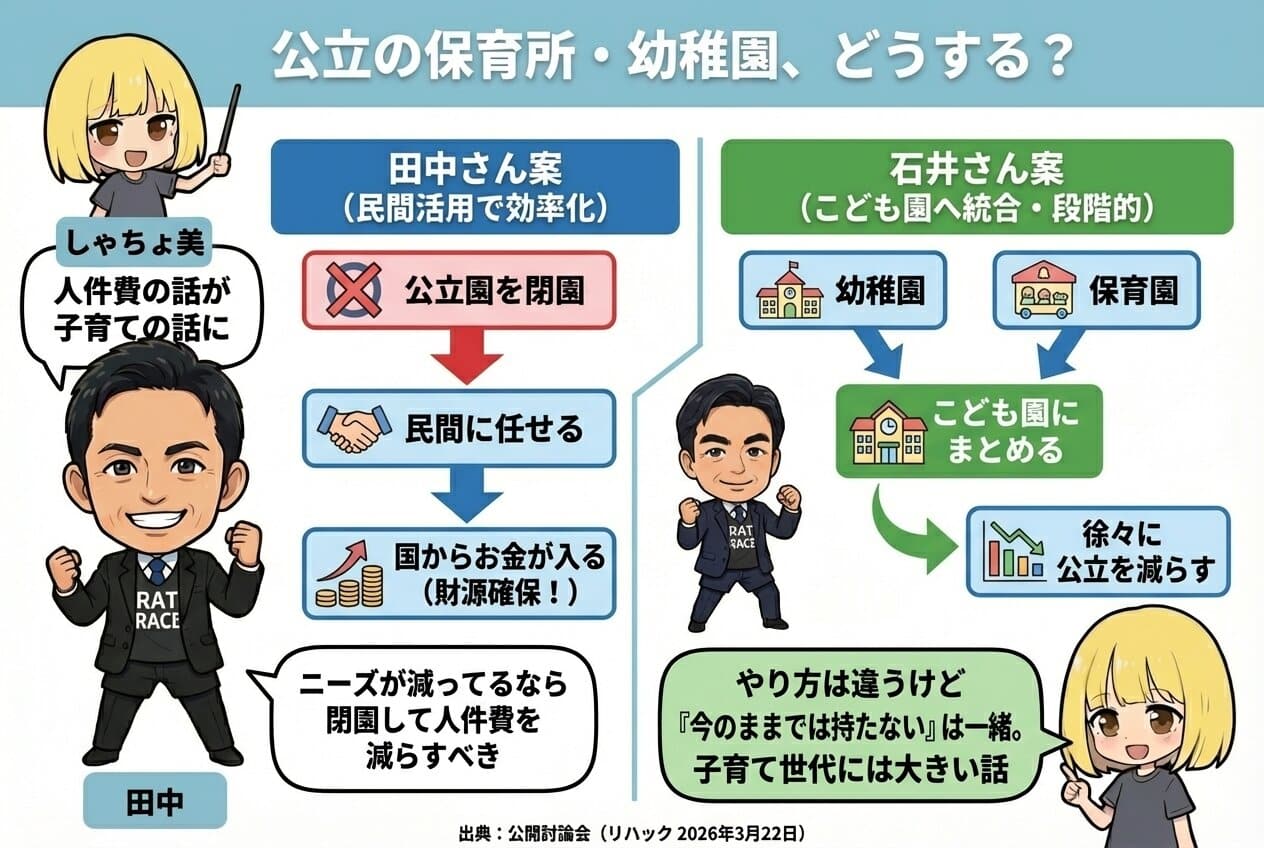
If public nursery schools are entrusted to the private sector, national funding becomes available. School lunch cooking should also have been outsourced to the private sector. With eight years, staff could have been reduced by not replacing people who left
When I took office, there were 23 public nursery schools plus 13 public kindergartens, for a total of 36. We’re working toward reorganizing and consolidating that into 23. In some cases, private and public facilities will operate side by side while the number of public ones is gradually reduced
Our thinking is completely different. Since fewer children are attending public kindergartens, they should be closed, not consolidated. After Ishii became mayor, he changed the policy of “closing them down”
When I took office, there was no next plan beyond closing the targeted kindergartens. Rather than leaving kindergartens and nursery schools separate, consolidating them into certified childcare centers is more in line with the times
Tanaka’s approach is “close facilities and reduce personnel costs,” while Ishii’s is “consolidate them into certified childcare centers and change how they’re maintained.” The methods differ, but both share the idea that “things can’t continue as they are.” However, the result changes “where children will be accepted,” so this is a huge issue for families raising kids

By the way, as we wrote in Part ① on child-rearing, while Nishinomiya has 76 children officially on waiting lists, there are actually 1,148 people who couldn’t get in. “What to do with public childcare facilities” is an issue that feels even more urgent than the numbers suggest.

A roundup of the three Nishinomiya mayoral candidates’ childcare policies and what they say about waitlisted children

2026年3月22日

❹ This is where the mood changed: the integrated hospital and “transitional care”

Up to this point, the first few topics had been an intense Ishii vs. Tanaka exchange, but ❹ was a little different.

This was where Hatamoto’s own distinctive focus came through most clearly 🏥

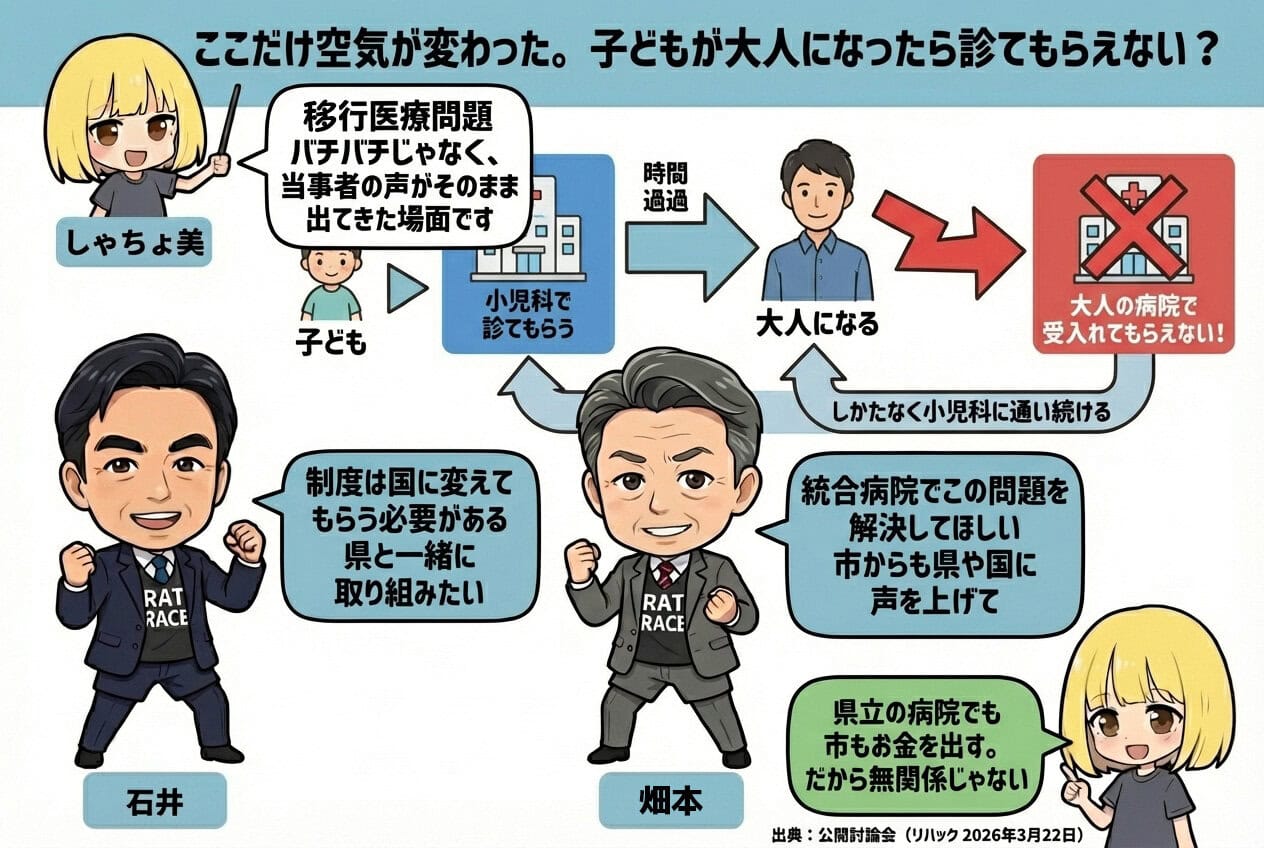
When children with disabilities become adults, pediatrics can no longer treat them. But they can’t find an adult hospital that will accept them, so they have no choice but to keep going to pediatrics. At the integrated hospital opening this July, I want this issue, as well as digitalization and disaster response, to be properly advanced
This is a highly specialized topic, and regarding the command center(something like the control room for the whole hospital), I’d like you to teach me about it. I’d like to study it together with you, including medical fee reimbursement
The mood here was a little different from the heated finance debate. It was a moment where the difficulties faced by those directly affected came out plainly. You might think, “Isn’t this a prefectural hospital, so why is it an issue in the mayoral election?” But since the city is also contributing money, it really does matter

Hatamoto also asked both Ishii and Tanaka about this theme at the Junior Chamber debate, so I think this is probably the topic he feels most strongly about.

❺ Are the garbage bag rules okay as they are?

The last topic that came up was garbage bags. It was covered pretty briefly in the debate, but because it’s so close to daily life, Shachomi thinks a lot of people are probably interested in it!

When Takahashi asked, “Are the garbage bag rules going to change?”…
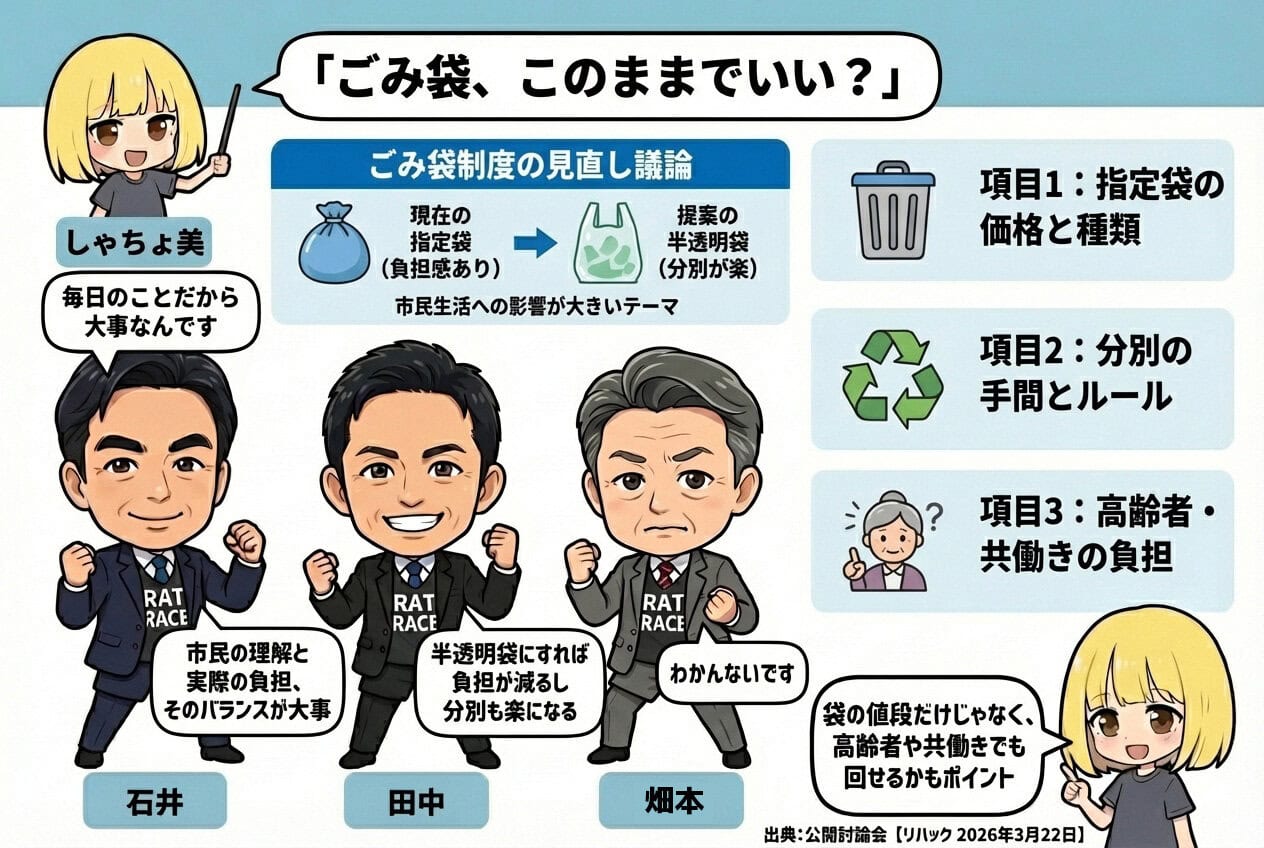
The container system changed to a bag system. We have heard comments like, “I only drink two cans, so why do I have to go out of my way to buy a bag?” First, we’ll continue with the current method while listening to residents’ opinions and thinking about it. It’s important to properly sort garbage and increase recycling
People don’t really understand what positive effects came from switching to designated bags. Do we really need two types of designated bags? If we use semi-transparent bags, it would reduce the burden on residents and make sorting easier
I don’t know

西宮市の求人情報

准看護師/西宮市/兵庫県/門戸厄神徒歩4分/介護関連施設
西宮市立介護老人保健施設すこやかケア西宮 兵庫県 西宮市
時給1,390円~1,590円
看護助手/ケアミックス病院/日勤/資格、経験 不問
医療法人純徳会 田中病院 兵庫県 西宮市
「残業ほぼなし」施設長・管理職/資格必須/正職員/日勤のみ/訪問看護/社会保障完備
医療法人社団幸泉会/高田上谷病院 訪問看護ステーション 兵庫県 西宮市
月給50万円~
訪問看護の看護師/准看護師
訪問看護ステーション24 兵庫県 西宮市
時給2,000円
「資格必須」看護師・准看護師/訪問看護
株式会社メディケア・リハビリ 兵庫県 西宮市
月給32万5,000円~35万円
Sponsored by 求人ボックス