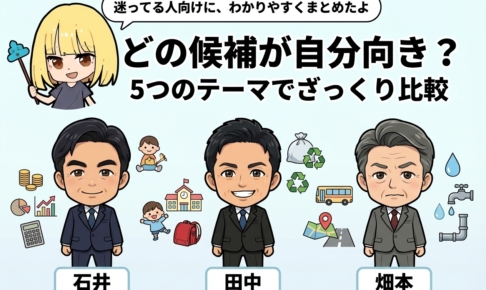

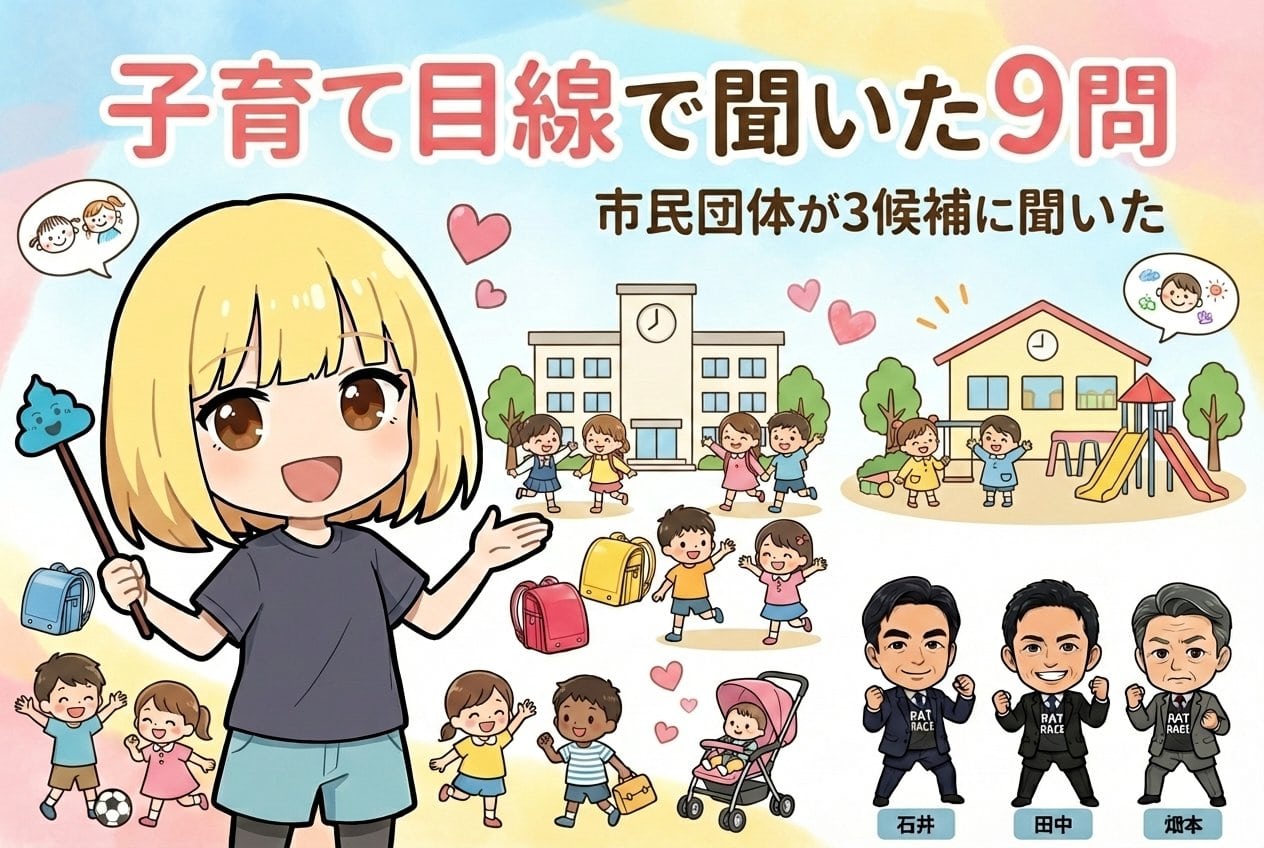

A network of 10 citizen groups in Nishinomiya involved with children and child-rearing sent an open questionnaire to the three mayoral election candidates, and it looks like all of them responded.

First, here’s the response list
The three candidates answered “Yes” or “Other” to 9 questions across 6 themes.
| Question | Ishii | Tanaka | Hatamoto |
|---|---|---|---|
| ❶ Establishing an ordinance on children’s rights | Yes | Other | Yes |
| ❷ Reflecting children’s opinions in policies | Yes | Yes | Yes |
| ❸ Continuous support regardless of age | Yes | Yes | Yes |
| ❹ Safe and secure school policies | Yes | Other | Yes |
| ❺ Strengthening support outside school | Yes | Yes | Yes |
| ❻ Gender equality policies | Yes | Other | Yes |
| ❼ Inclusive education | Yes | Other | Yes |
| ❽ Promoting citizen participation | Other | Yes | Yes |
| ❾ Public-private information sharing | Other | Other | Yes |
※ “Other” does not mean opposition; it indicates a conditional answer or a different approach. Please see each theme’s response for details.
Detailed Responses by Theme
❶ Establishing an ordinance on children’s rights
Question: Will you move forward with establishing a comprehensive ordinance to protect children’s rights?
Ishii(Yes)
I would like to create an ordinance that would serve as the basis for establishing a third-party body to protect children’s human rights.
Tanaka(Other)
Based on national law, I believe we should consider establishing such an ordinance only after confirming its effectiveness as a practical ordinance that can serve as the basis for initiatives supporting the growth of children who will carry the future, through dialogue with citizens including children, and dialogue with council members in the assembly.
Hatamoto(Yes)
An ordinance is a means. The ultimate goal is to create a city where every child can “think for themselves, speak up, and participate in society.”
❷ Reflecting children’s opinions in policies
Question: Will you strengthen measures to reflect children’s opinions in the planning and implementation of policies related to children?
Ishii(Yes)
We have already carried out various initiatives to listen to children’s voices, and we will continue to listen to children’s opinions at every opportunity while finding ways to reflect them in policy.
Tanaka(Yes)
I believe this is important from the perspective of citizenship education as well.
Hatamoto(Yes)
The value is not simply in “listening” to children’s opinions. What matters is giving children the experience of being involved in self-determination and accepting the results. The exact same thing applies to the city’s policies for children. Reflecting opinions means making children participants in city-building. The administration must be prepared to welcome them not as guests, but as equal partners.
❸ Continuous support regardless of age
Question: Will you strengthen seamless support for school-age children, junior and senior high school students, and older generations?
Ishii(Yes)
Through learning support programs for households in need and support systems for university and other entrance exam costs, we will ensure that opportunities are not lost for economic reasons. The new library will also support young people, including older teens, by creating a section for them.
Tanaka(Yes)
I have made proposals on this in the city council. I believe we need to work broadly on support for mothers and children before and after childbirth, support for early childhood education, creating after-school places for school-age children, preserving the educational significance of club activities in junior high schools, securing places for children and young people, reducing the burden of commuting costs for high school students, and improving the effectiveness of support for young carers. To secure the funding for this, we must carry out fiscal reform based on thorough city hall reform.
Hatamoto(Yes)
At the root of the problem of support ending at a certain age is a structure in which the administration is fixed as the side that “provides services,” while children and young people are fixed as the side that “receives” them. Rather than dividing support by age, Nishinomiya should build a system as part of its foundation that continues to accompany each individual in the process toward autonomy.
❹ Safe and secure schools + ❺ Support outside school
Question: Will you work with the Board of Education to create safe and secure schools? Will you strengthen support systems in the community?
Ishii(❹Yes ❺Yes)
❹ We will encourage updates to basic values so that schools themselves become places children want to go.
❺ There are many possible cases, and because the situations are diverse, I believe having more options is better. I would like to expand support together with existing measures.
Tanaka(❹Other ❺Yes)
❹ I believe we should take on the challenge of developing an environment where AI is used to support learning tailored to each individual. The ideal is an environment where every child can develop the “zest for living” needed to adapt to the VUCA era before entering society as an adult.
❺ I would like to work on expanding child-rearing plazas, improving park environments, supporting the enhancement of Sports Club 21, supporting multigenerational exchange at local children’s cafeterias, supporting children who do not attend school through the use of alternative schools, enhancing after-school kids programs, and preserving the educational significance of club activities.
Hatamoto(❹Yes ❺Yes)
❹ In Nishinomiya, we will work with the Board of Education to introduce a system in which all teachers serve as homeroom teachers, allowing children to choose who they consult with. School rules should be reviewed through dialogue among students, teachers, and guardians by asking, “What are these rules for?” What matters is not a change in systems, but a shift in school culture that returns children from being “subjects of management” to being “agents of learning.”
❺ The goal of support for children who do not attend school is not to “return them to school.” It is for every child to learn in an environment that suits them, connect with others, and move toward autonomy. The administration has a responsibility to expand those options.
❻ Gender equality + ❼ Inclusive education
Question: Will you implement policies to eliminate discrimination based on gender or sexual orientation? Will you promote inclusive education?
Ishii(❻Yes ❼Yes)
❻ A society where people respect each other’s individuality is important. We will continue working toward mutual understanding in pursuit of an inclusive society.
❼ We will continue working based on the fundamental idea of inclusion: the importance of learning while respecting each person’s individuality.
Tanaka(❻Other ❼Other)
❻ I am not considering major changes to the current initiatives, but I believe continuous effort is needed so that they support children’s growth.
❼ I believe inclusive education from early childhood, including childcare, needs to be implemented through public-private cooperation. It is necessary to ease and provide measures for additional staffing requirements at private nursery schools, certified centers for early childhood education and care, and private kindergartens.
Hatamoto(❻Yes ❼Yes)
❻ In Nishinomiya, we will first review the systems and practices of schools themselves. This includes optional uniforms, class rosters and facility operations that do not depend on gender, and creating spaces where children themselves think about rules through dialogue. The starting point for eliminating discrimination is guaranteeing, as a system, an environment where “everyone is different, and that is normal.”
❼ The question should not be “separate or not separate,” but whether an environment is in place where every child can safely choose their learning based on their own will. The essence of inclusion is not moving children, but changing the environment.
❽ Citizen participation + ❾ Public-private information sharing
Question: Will you promote citizen participation in policy decisions, including guardians and people involved with children? Will you promote public-private information sharing that includes information from local NPOs and civic activities?
Ishii(❽Other ❾Other)
❽ I would like to examine how issues can be improved and shape them into a good form.
❾ We will consider what specific approaches may be possible.
Tanaka(❽Yes ❾Other)
❽ Through my experience as a city council member, I established the political stance that “there is no true policy without dialogue with citizens,” rather than looking at things only from the administration’s perspective. I believe the mayor must exercise leadership so that the administration and all city hall staff share this awareness. Dialogue with the council members chosen by citizens is also important. I would like to strengthen cooperation among industry, government, academia, and citizens.
❾ I believe it is undesirable to favor specific organizations, and accurate information sharing is needed so that parents and guardians can broadly and correctly understand the protection of children’s rights.
Hatamoto(❽Yes ❾Yes)
❽ Before promoting citizen participation, there is something we must first question: why citizens are not participating now. It is because the structure has become fixed, with the administration as the side that “provides services” and citizens as the side that “receives” them, causing citizens themselves to lose a sense of ownership. What the administration should do is not manage those people, but work with them as equal partners to put the highest-level goals into words and build consensus through dialogue.
❾ It is not about the administration taking in private-sector information and “delivering it correctly.” It is about creating places where on-the-ground information held by children’s cafeterias, free schools, parent groups, and local supporters naturally connects with the administration’s information on systems and services.
About This Open Questionnaire
This questionnaire was sent to each candidate in the Nishinomiya mayoral election by the “Citizen Group Network for Children and Child-Rearing(Nishinomiya Children’s Citizen Group Network).”
Ten groups in Nishinomiya have endorsed it↓
・インクルネット西宮
・LGBTQ ユースサポート・プライドプロジェクト
・こどもと未来を創るプロジェクト
・特定非営利活動法人 こどもサポートステーション・たねとしずく
・どんな子も暮らしやすい西宮を考える会
・特定非営利活動法人 なごみ
・にしのみやこどもと学びネットワーク(29団体)
・西宮不登校親の会
・認定NPO法人 みやっこサポート(事務局団体)
【Advisor】Kwansei Gakuin University Professor Emeritus Yoshihiro Okamoto
You can view the full questionnaire(PDF)here.
【Sources】
・Nishinomiya Mayoral Election 2026 Open Questionnaire(Citizen Group Network for Children and Child-Rearing, March 24, 2026)
・Original responses from each candidate
Here is Nishitsu’s article on the five themes it asked the candidates about↓