

Welcome to “Nishitsu Nante Iu?”, a series where we ask readers what they call certain things in Nishinomiya and turn the results into articles.
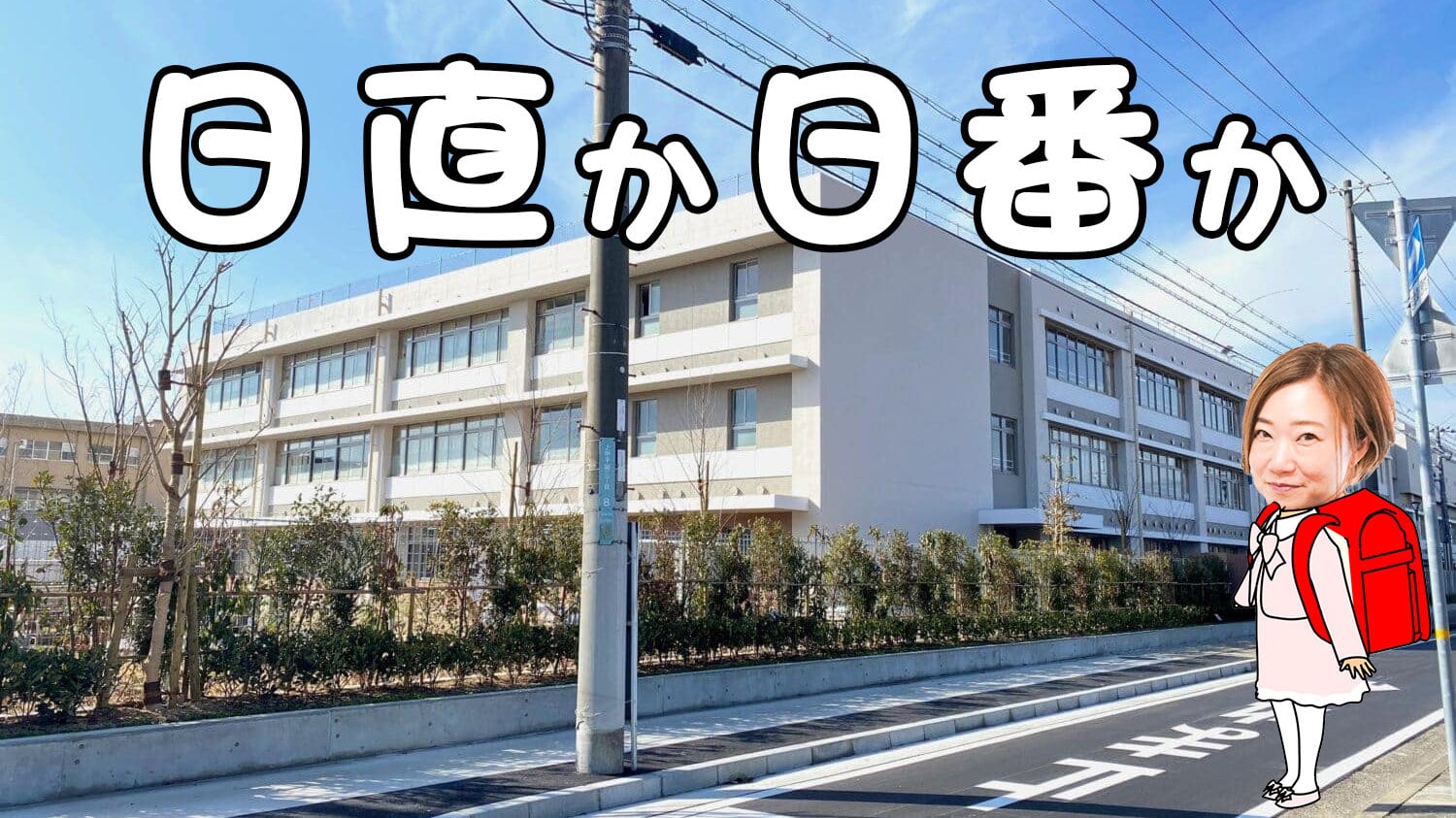
This time, the question is: what do you call “n番 / nicchoku”?
We received 140 responses to the survey about “n番 / nicchoku”!
We had asked for responses quite a while ago, and completely forgot to publish the results~m(__)m
So, in Nishinomiya, is it nicchoku? Or nichiban? Let’s announce which one was more common!! Oh, apparently “nicchoku toban” might be the official term? Did you know that?
Survey Details
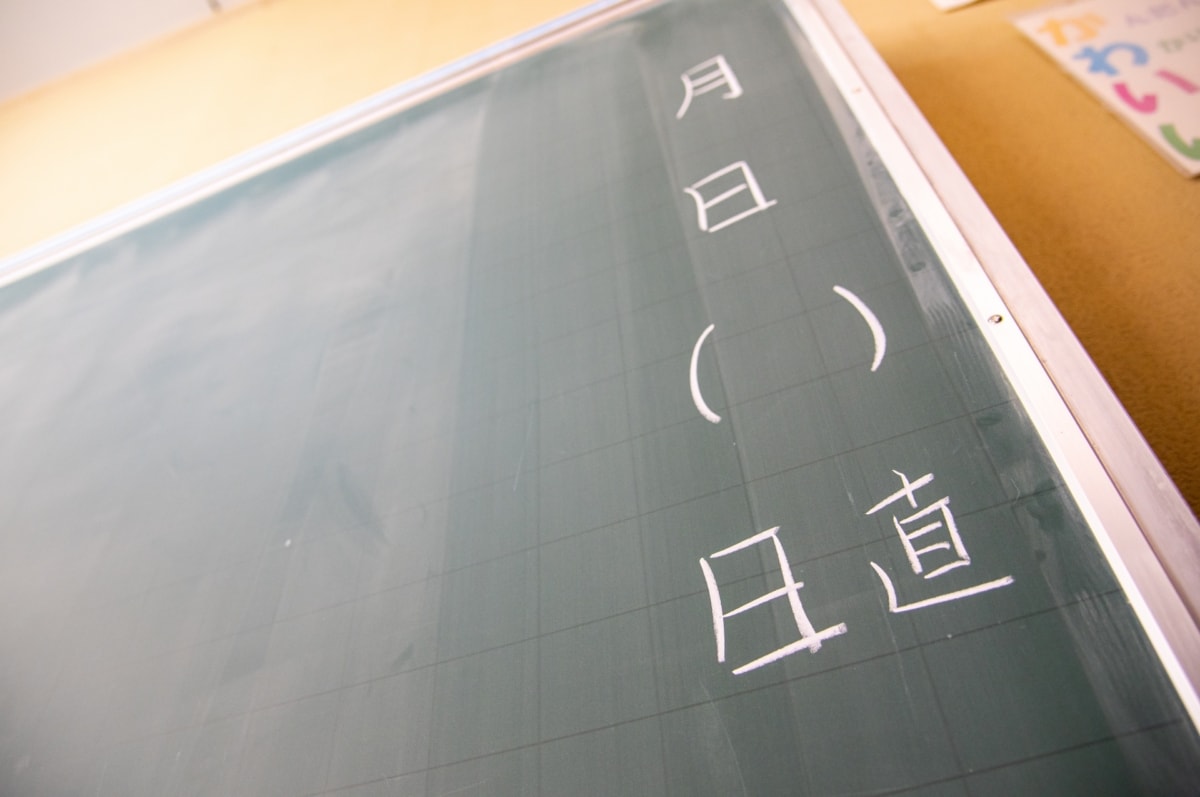
- What do you call the daily classroom duty?
- “Nicchoku,” “Nichiban,” or “Other”
- If you chose “Other,” please tell us exactly what you call it
- If you’re in Nishinomiya, your elementary school name; otherwise, prefecture + city
What Do You Call Daily Classroom Duty?
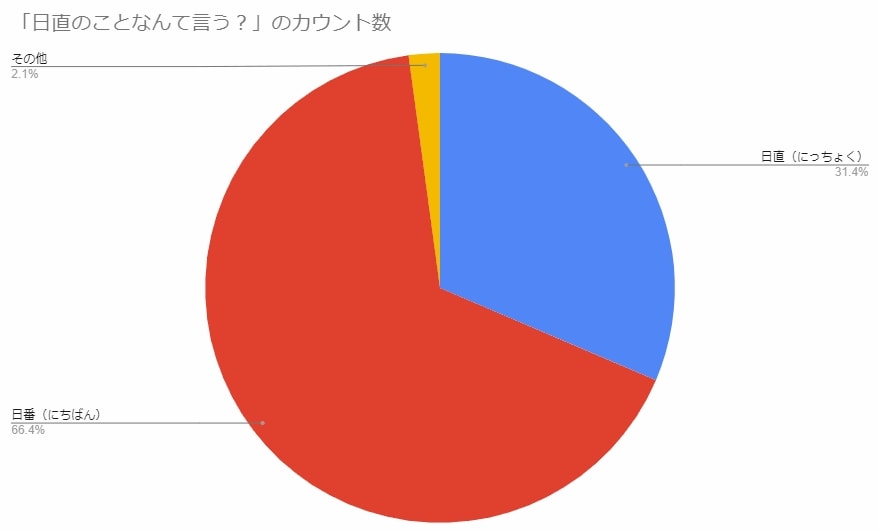
- Nichiban was more common than nicchoku~
- For “Other,” there were only three responses: “tanbon,” “toban,” and “I say both.”
So what did it look like by elementary school in Nishinomiya?
By Elementary School in Nishinomiya
| Elementary School | Nicchoku | Nichiban |
|---|---|---|
| Yasui | 1 | 1 |
| Kawaragi | 3 | |
| Kawabayashi | 3 | |
| Hirota | 4 | |
| Koshienhama | 1 | |
| Koto | 3 | |
| Koyoen | 1 | 3 |
| Koroen | 2 | |
| Takasuhigashi | 1 | 1 |
| Takagi | 2 | |
| Imazu | 2 | |
| Shukugawa | 1 | 1 |
| Harukaze | 4 | |
| Uegahara | 2 | |
| Uegahara Minami | 1 | |
| Kami-Koshien | 1 | |
| Fukatsu | 1 | 1 |
| Taisha | 3 | |
| Danjo Nishi | 1 | |
| Tsuto | 2 | |
| Higashi-Koshien | 1 | |
| Minami-Koshien | 1 | |
| Hinokuchi | 3 | |
| Hamawaki | 1 | 1 |
| Hiraki | 1 | |
| Kita-Shukugawa | 1 | 2 |
| Naruo Higashi | 1 | |
| Naruo Kita | 1 | 2 |
| Yokai | 1 | |
| 10 | 52 |
Among Nishinomiya kids, the share who say nichiban is 82%!
Based on the responses we received, Koyoen, Higashi-Koshien (now merged into Koshienhama Elementary School), Minami-Koshien, Kita-Shukugawa, and Naruo Kita say nicchoku.
So what about places outside Nishinomiya?
Nicchoku and Nichiban Outside Nishinomiya
| Prefecture or City | Nicchoku | Nichiban |
|---|---|---|
| Tatsuno City | 1 | |
| Ashiya City | 2 | |
| Itami City | 2 | |
| Iwate Prefecture | 1 | |
| Hiroshima Prefecture | 1 | |
| Kochi Prefecture | 1 | |
| Sakai City | 1 | |
| Kobe City | 12 | |
| Ishikawa Prefecture | ||
| Shimane Prefecture | 1 | |
| Tokyo | 1 | |
| Higashiosaka City | 1 | |
| Amagasaki City | 3 | |
| Himeji City | 1 | |
| Takarazuka City | 1 | 1 |
| Akashi City | 1 | 1 |
Amazingly, all 12 people from Kobe City said nichiban! Ashiya City also says nichiban. Amagasaki City too says nichiban.
In Takarazuka City and Akashi City, there are people who say nicchoku.
What we can tell from this is that, at the very least, everyone outside Hyogo Prefecture says nicchoku. The entries in red in the table are in Hyogo Prefecture.
Earlier, among Nishinomiya elementary schools, 10 people said nicchoku.
So we started wanting to look into it a little more closely.
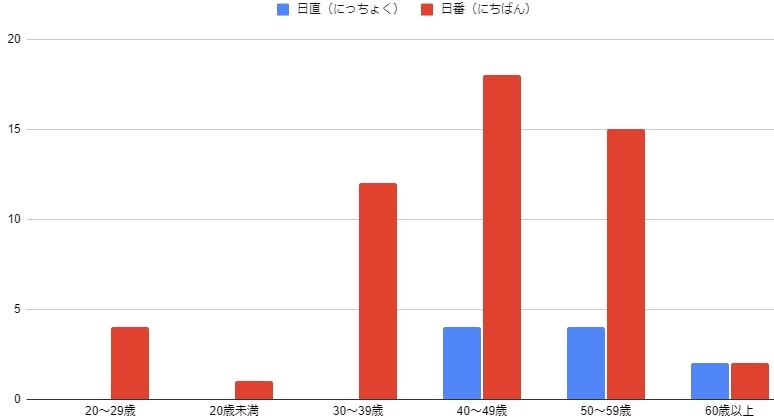
Maybe age has something to do with it too.
Let’s take a quick look.
Ah!
Everyone in their 30s or younger says nichiban.
On the other hand, some people in their 40s or older say nicchoku.
We can’t say for sure, but there may be an age-related tendency.
In Closing
From these results, we learned that, at least in southern Hyogo Prefecture, people say nichiban. Somehow it feels like everyone in Kobe probably says nichiban too, so Kobe might be the center of the nichiban faction. Kobe Journal, please look into this~. Just saying that on our own.
If you have children, try asking them what they call it.