
Nishinomiya Mayoral Election Debate Recap Candidates Ask Each Other Tough Questions

This page is automatically translated. Please refer to the original Japanese for accuracy.
しゃちょ美@にしつー
にしつー

Summary of the public debate for the Nishinomiya mayoral election hosted by the Junior Chamber: Part 3: The Debate & Wrap-up Edition

Previous articles are here↓

Summary of the Nishinomiya Mayoral Election Debate: “Money” Edition — Explaining the City’s Finances

2026年3月24日

Summary of “Childcare” Policies from the 3 Candidates in the Nishinomiya Mayoral Election: What They’re Saying About Waitlisted Children

2026年3月22日
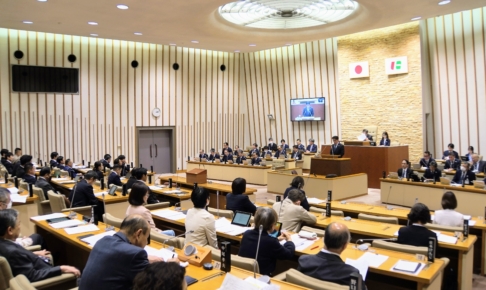
This time, we’re summarizing the part where the candidates called on each other directly and asked questions. This was the most interesting part〜

These weren’t prepared answers. It was about how they responded when pressed. You could really see their true thoughts

※At the debate, there were two rounds: a “finance theme” and a “free theme.” Nishi2 has arranged them in order of how lively they felt

First, the big picture. Who challenged whom?

There were two moments during the debate where the candidates selected another candidate and asked them a question.

Here’s the question pattern

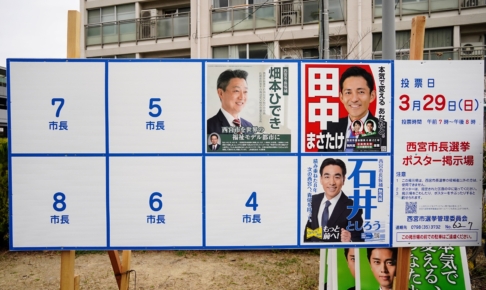
Tanaka-san chose Ishii-san both times (a clear sense of rivalry toward the incumbent)
Hatamoto-san asked Ishii-san, then Tanaka-san, in a balanced way
Ishii-san asked Hatamoto-san, then Tanaka-san, questioning both

Who they asked, and what they asked about, reveals what was on their mind the most〜

Let’s take a look one by one〜

6 serious questions between the candidates

To make it easier to understand, these are not word-for-word quotes, but the content is almost exactly the same〜

❶ Tanaka-san → Ishii-san: “Why haven’t you been able to eliminate childcare waiting lists after 11 straight years?”

🏷️ The sharpest question
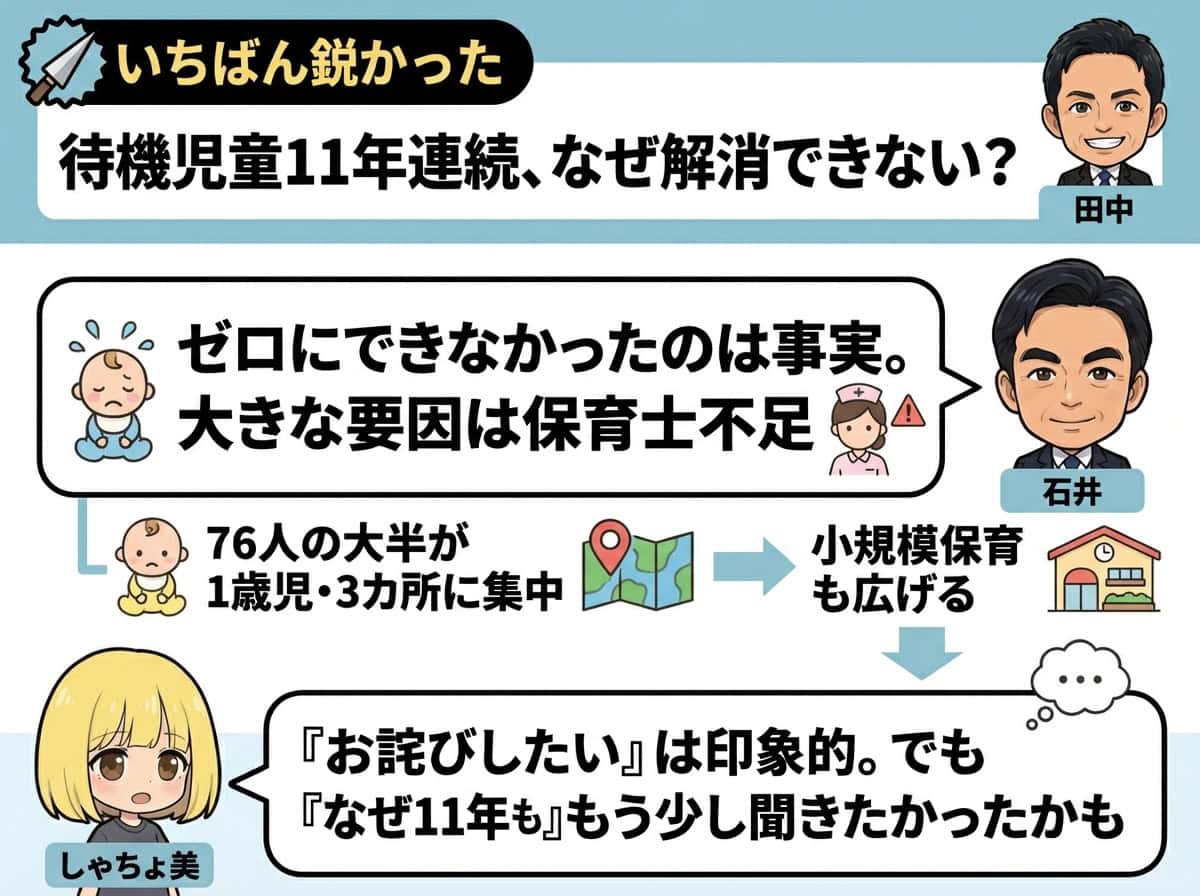
If you say “delivering results is important,” how do you view the result that there have been children on waiting lists for 11 consecutive years?
It is true that we were unable to bring the number down to zero, and I would like to apologize to those who ended up on waiting lists. The biggest factor is a shortage of childcare workers. Of the 76 children, most are one-year-olds, and they are concentrated in three areas of the city. We will also continue expanding small-scale childcare
It was striking that he clearly said, “I would like to apologize.” But as for the root of “why for 11 years,” the answer centered on the shortage of childcare workers, so we kind of wanted to hear a little more. We also wrote about this in detail in Part 1: Childcare Edition〜↓

❷ Tanaka-san → Ishii-san: “You say you’ll limit new projects, so how will you do new things?”

🏷️ Pointing out a contradiction
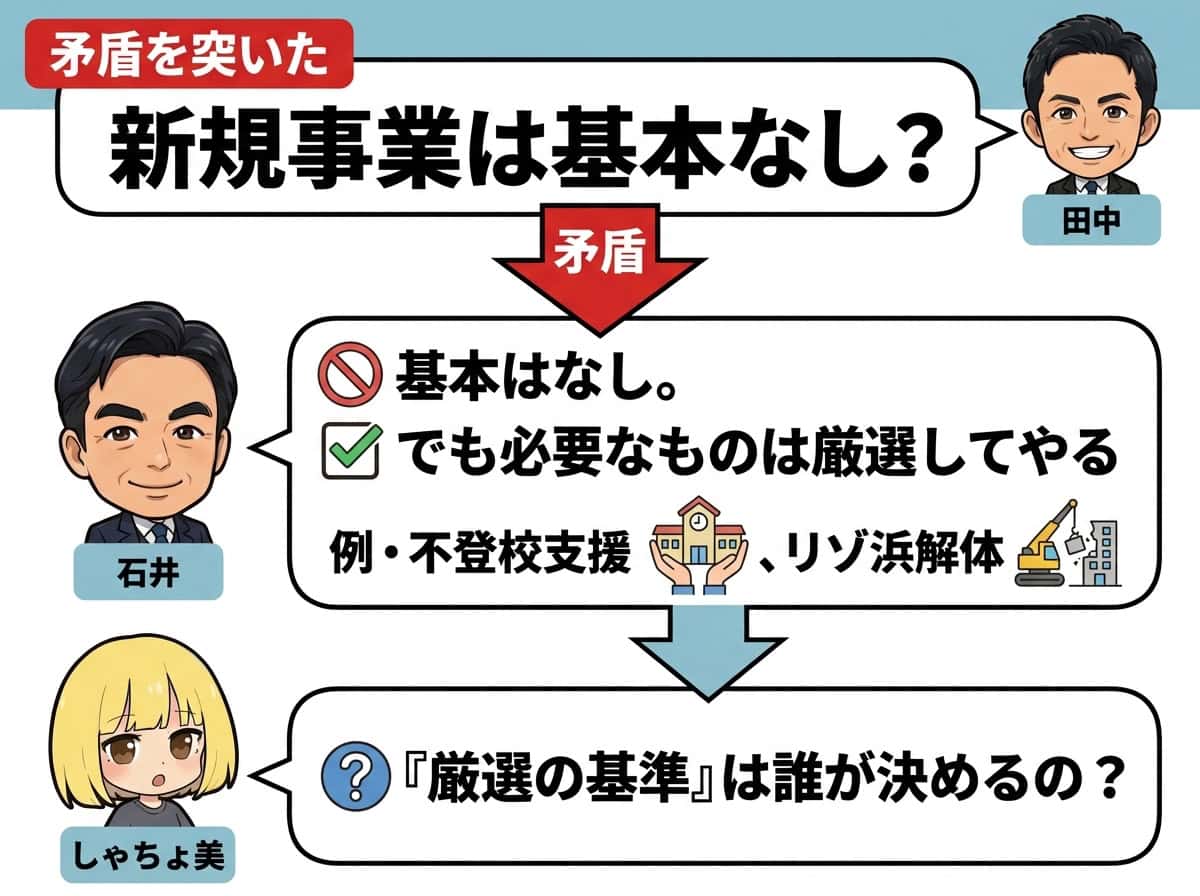
For fiscal 2026, you issued a notice saying “basically no new projects,” right? But just now, you’ve been saying you’ll do all kinds of things. Isn’t that a contradiction?
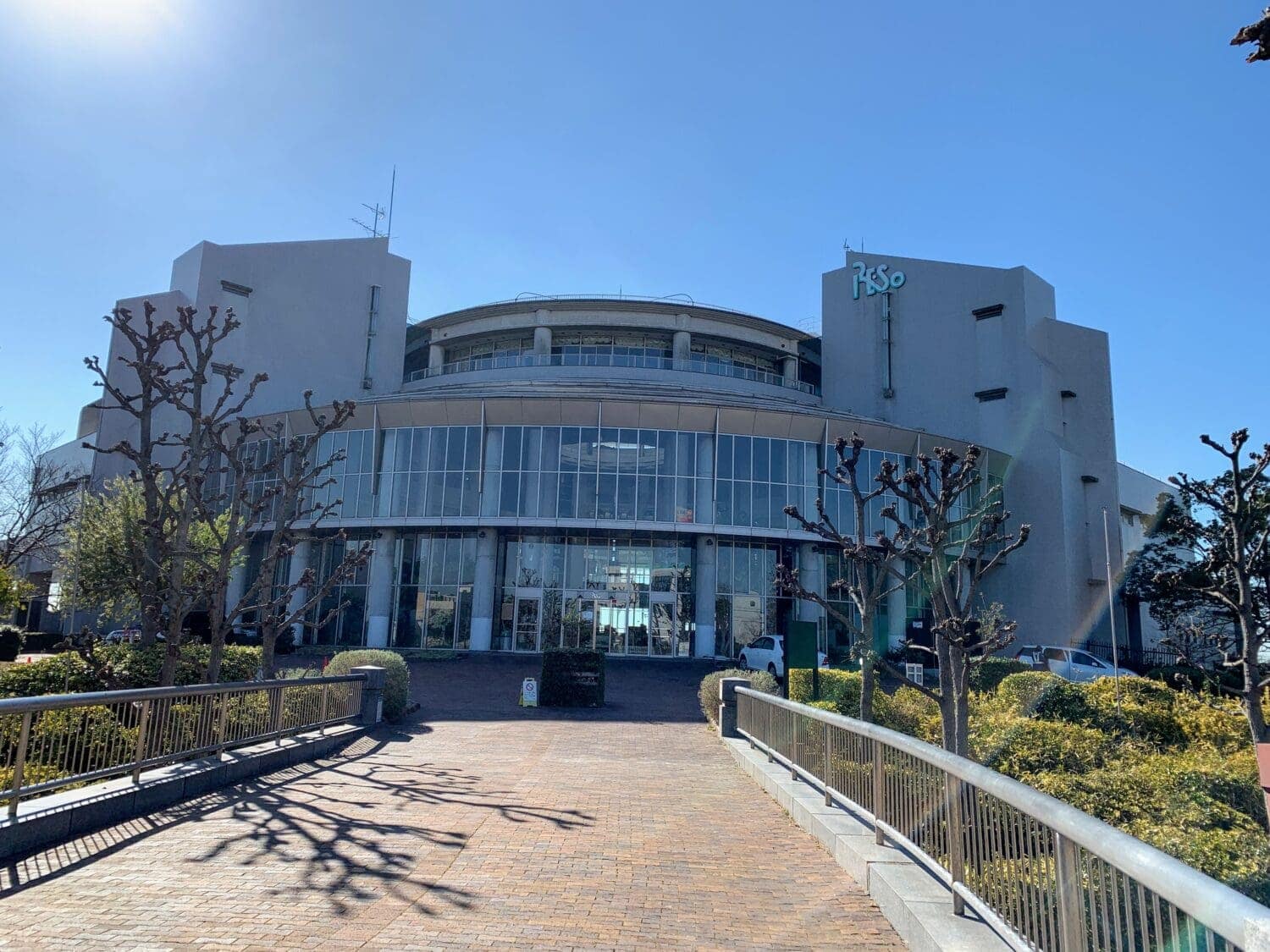
It is “basically none,” but we will carefully select and approve projects that are truly necessary. For example, expanding support for students who are not attending school, or the budget to demolish Rizo Hama. For projects that cannot be stopped, we will combine them with others so they do not expand unnecessarily
The remaining question may be: “Who decides the criteria for that careful selection?”

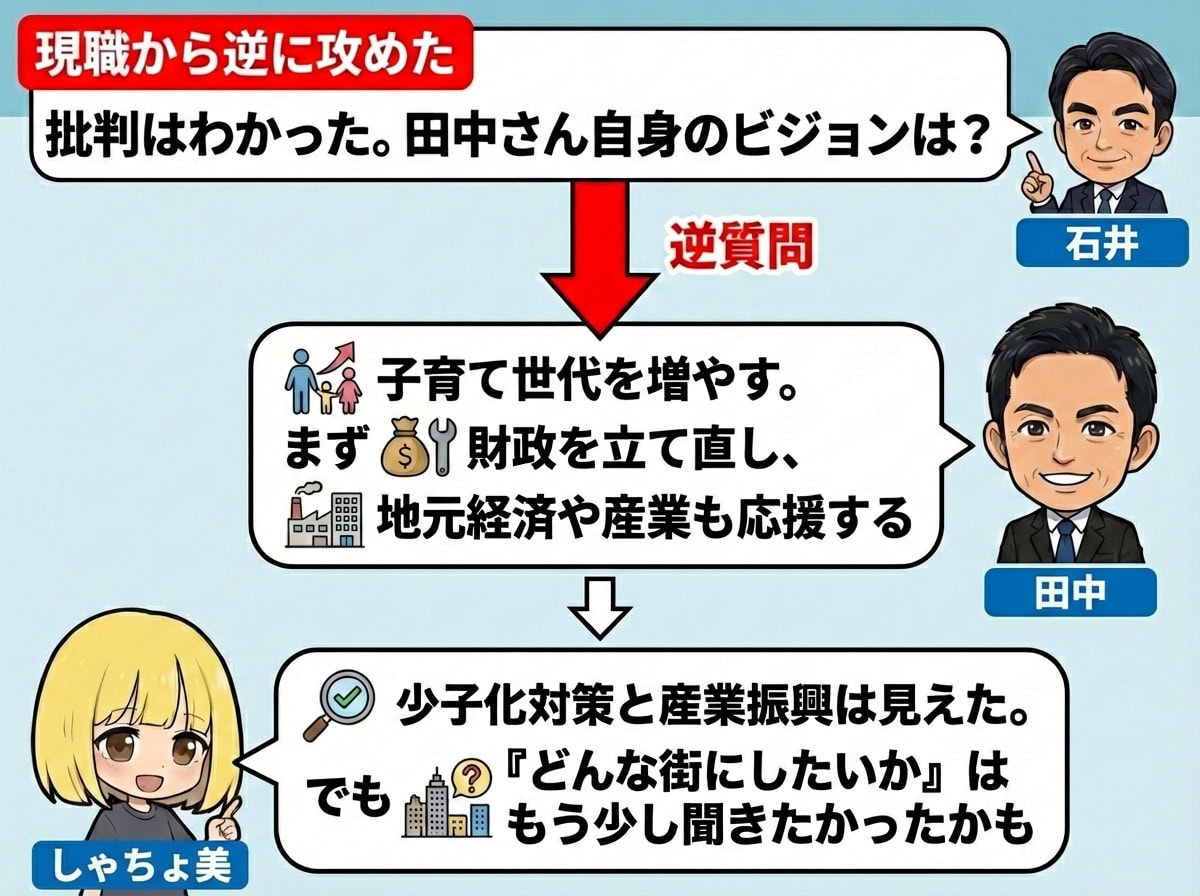
❸ Ishii-san → Tanaka-san: “I understand the criticism. Please tell us your own vision for Nishinomiya.”

🏷️ The incumbent pushed back

I read the flyer Tanaka-san has been handing out. I understand the strong criticism of the current city administration. So I would like to hear what kind of Nishinomiya Tanaka-san himself is aiming for, along with his vision and broad direction
Population decline is a serious issue in the Hanshin area, where populations have begun to fall. The most important thing is to increase the number of families raising children. First, I want to rebuild the city’s finances, and also support the local economy and industries
He mentioned “measures against the declining birthrate” and “industrial promotion,” but it felt like he didn’t go quite far enough into what Ishii-san probably wanted to hear: “specifically, what kind of city do you want to make?”

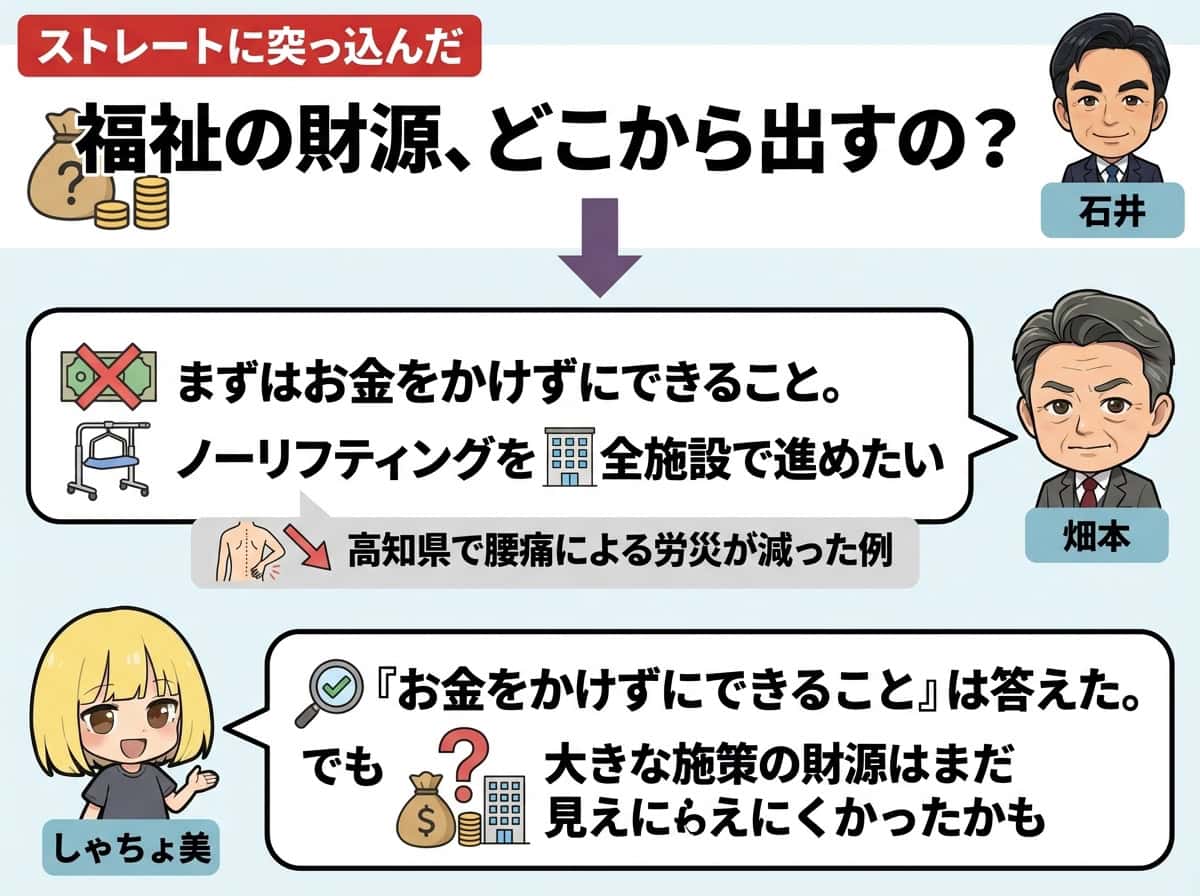
❹ Ishii-san → Hatamoto-san: “Where will the funding for welfare come from?”

🏷️ A direct challenge

I think the vision of becoming a model welfare city is wonderful. So which areas would you expand, and where would the funding come from?
“Welfare-focused Nishinomiya” is already known among groups such as the national parents’ associations I’m involved with. First, we should implement no-lifting care, which can be done without spending money, at all facilities. Kochi Prefecture has a track record of reducing workers’ compensation cases caused by back pain
He answered with “things that can be done without spending money,” but the part about “where the funding would come from for policies that require major spending” didn’t feel very clear…

※No-lifting care refers to care methods in nursing and caregiving settings where staff do not “lift, carry, or drag” users’ bodies

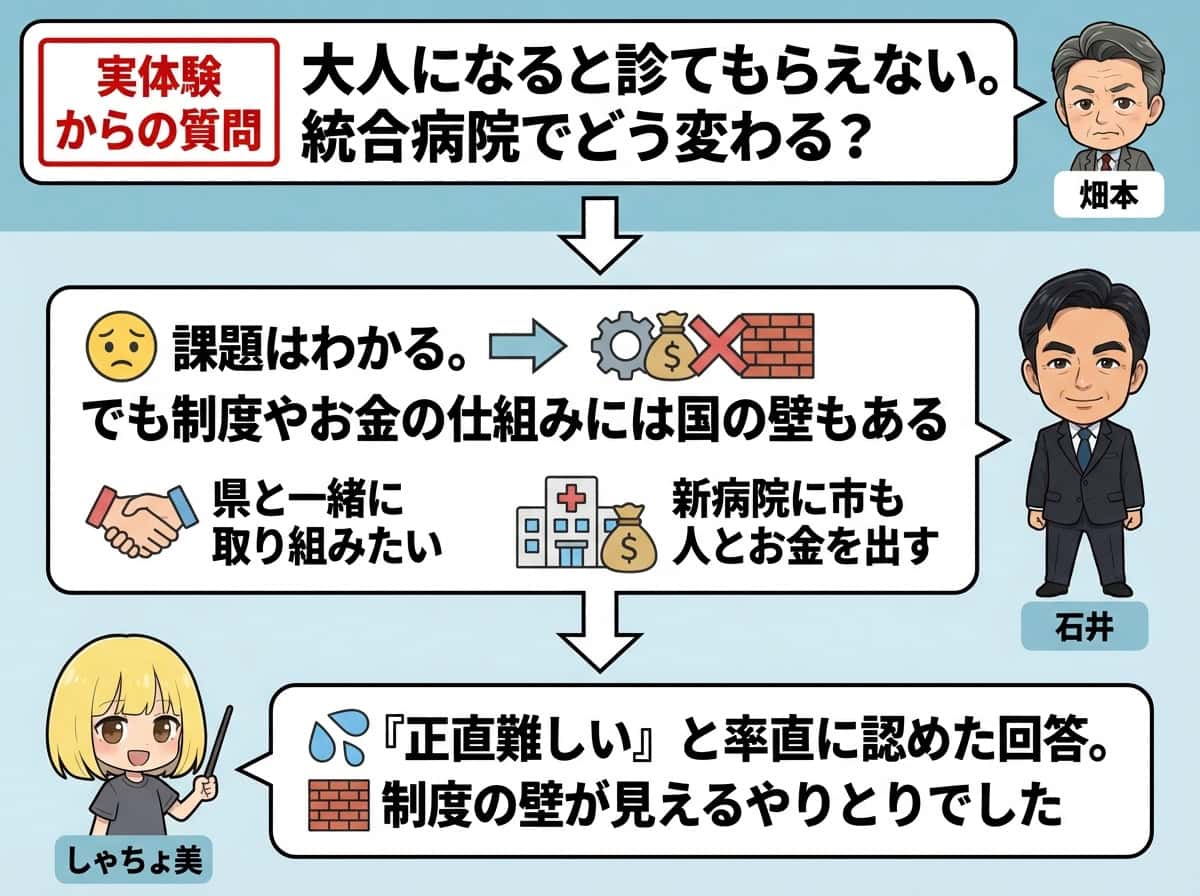
❺ Hatamoto-san → Ishii-san: “With the integrated hospital, how far will transitional medical care and emergency systems move forward?”

🏷️ A question from personal experience

My son has a disability, and only the thin needles used in pediatrics can be used for him. Once he becomes an adult, it becomes difficult to find places that will see him. Will this “transitional medical care” and DX for emergency services move forward at the integrated hospital?